
In his lecture series Human and Cosmic Thought, Rudolf Steiner explained the importance of understandings from twelve different worldviews — from materialism to spiritualism, from idealism to realism — in order to attain a balanced view of the whole. In the introduction to the 1991 English translation, Nick Thomas wrote that:
Rudolf Steiner shows that there are twelve main philosophical standpoints, and that fruitful progress in philosophy depends not upon ‘defending’ one and ‘refuting’ others, but in learning to experience the validity of them all. Different engineering problems require different tools, and it is senseless to say that a spanner should be used to refute a screwdriver. Similarly, some philosophical problems require the use of one standpoint, while others are best approached from a different direction. Philosophical sophistication here requires a deeper insight into all possible approaches. … It is only a pity that Steiner had to be so aphoristic here, although it does leave a rich field of research for others to explore.
So far I have only found two others who have explored this twelvefold concept in depth and interestingly both have taken two very different approaches. They are Tom Last and Mario Betti. Combining insights gained from Steiner, Last and Betti, as well as the results of my own thinking, I have provisionally characterised them as:
- Materialism – Materialist, objective belief – Opp. Spiritism.
- Mathematism – Idealist (sense free thinking) seeing of unified patterns formed from individual parts – Opp. Monadism.
- Rationalism – Idealist (sense free thinking) logical analysis enabling seeing structure in nature – deciding on a (moral) dynamic acton – Opp. Dynamism.
- Idealism – Idealist (sense free thinking), seeing via thinking (Plato) – Opp. Realism.
- Psychism – Spiritual observation that objects have souls – things are subjects – Opp. Phenomenalism.
- Pneumatism – Spiritual observation that objects are spiritual beings – Opp. Sensualism.
- Spiritism – Spiritual hierarchy, subjective view – Opp. Materialism.
- Monadism – Realist awareness (experiential knowledge [Wissen or Erfahrung?]) of individual spiritual entities acting from a (physical?) centre (Leibniz) – Opp. Mathematism.
- Dynamism – Realist awareness (experiential knowledge [Wissen or Erfahrung?]) of creative dynamic processes – acting on a rational (moral) decision – Opp. Rationalism.
- Realism – Experiential knowledge – object based thinking – [Wissen or Erfahrung?] of the world (Aristotle) [naive realism] – Opp. Idealism.
- Phenomenalism – Materialist observation of external (objective) phenomena – Opp. Psychism.
- Sensationalism – Materialist observation of internal (subjective) phenomena – Opp. Pneumatism.
- Please note that these descriptions are provisional and given for the purposes of thinking out loud and are an invitation to others to offer alternative suggestions or (constructive) criticism.
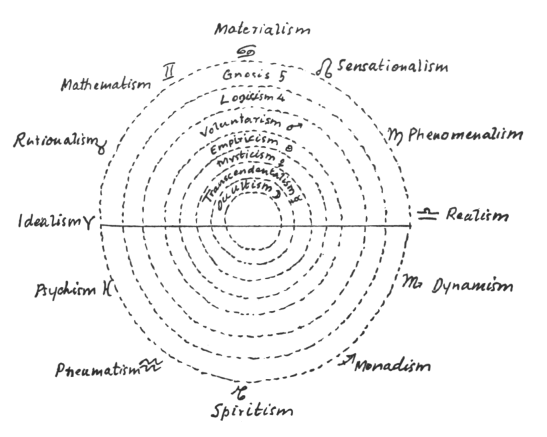
Five patterns appear:
- A complimentary polarity of opposites.
- A vertical polarity, with the upper six mostly associated with materialism, the lower six mostly associated with spiritualism.
- A horizontal polarity, with the left half mostly associated with idealism, the right half mostly associated with realism.
- A fourfold pattern:
- Materialism – closely associated with phenomenalism and sensualism (the latter two based on the physical senses).
- Physical
- Spiritism – closely associated with psychism and pneumatism (acquiring knowledge of super-sensible entities)
- Ego
- Idealism – closely associated with mathematism and rationalism (intellectual thinking, rising to pure sense-free thinking)
- Etheric(?)
- Realism – closely associated with monadism and dynamism (practical thinking)
- Astral(?)
Again, please note that these descriptions are provisional and given for the purposes of thinking out loud and are an invitation to others to offer alternative suggestions or (constructive) criticism.
- Astral(?)
- Materialism – closely associated with phenomenalism and sensualism (the latter two based on the physical senses).
- Within each fourfold pattern
- Moving anticlockwise
- The first worldview is concerned with the more outer aspects
- The second worldview is concerned with the more inner aspects
- The third worldview is concerned with the main subject.
- Moving anticlockwise
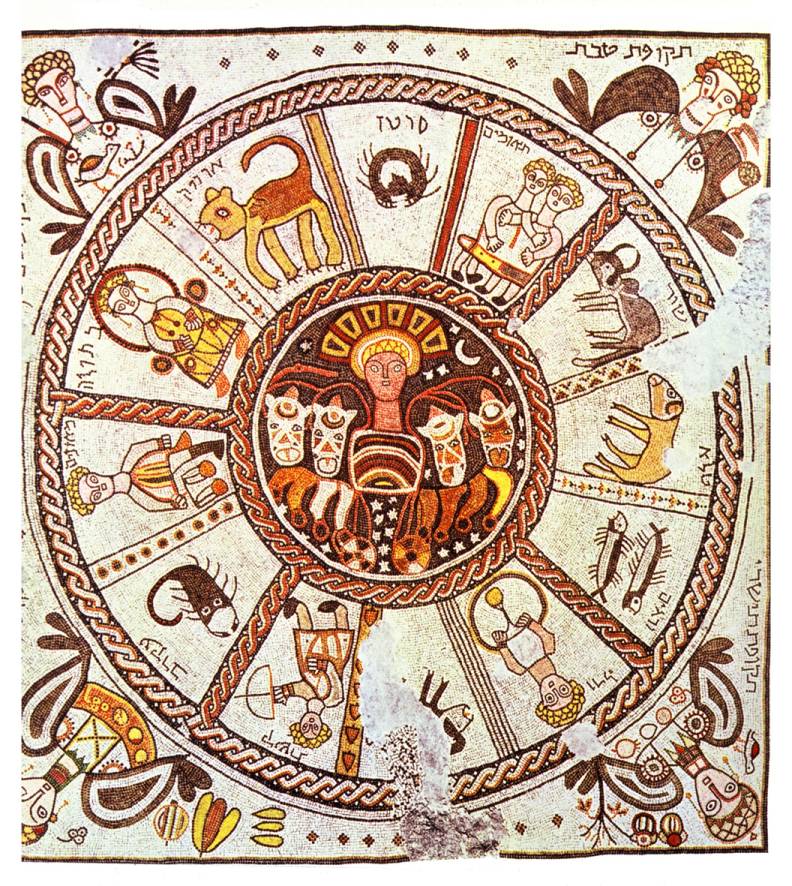
Steiner also linked each of the twelve worldviews with the zodiac signs. I struggled to find any articles or publications online by Rudolf Steiner or others to help me with this. Until I found the excellent book online, Speaking to the Stars: An Introduction to Astrosophy, a New Star Wisdom developed by Willi Sucher out of the insights of Rudolf Steiner by Jonathan Hilton
From the edited transcripts of a video course available on astrosophy.com, given by Jonathan Hilton in 2019/2020.
However, that is for a future post.


Leave a Reply