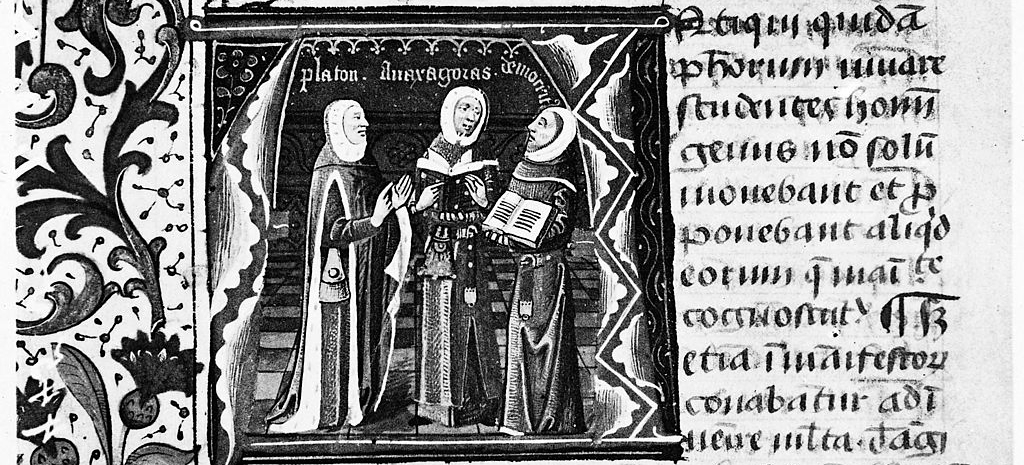
| This text is in a coloured box to separate it from the rest of the chapter. It is a comment about the second part of this working draft chapter, which started as a more or less conventional historical review of the early developments of chemistry in the West. The first parts of the Wikipedia page, History of Chemistry, were used as a template for this early draft. This update interweaves its content with Rudolf Steiner’s Riddles of Philosophy. Also used is E.J. Dijksterhuis, The Mechanization of the World Picture. |
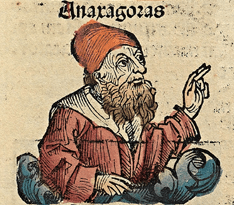
Anaxagoras was the first of the so called atomists. They primarily concerned themselves with the nature of material objects and their transformations. Though the Eleatics, who preceded them, concerned themselves with the Ideal realm of being, the atomists also respected their ideas:
The Greeks do not think correctly about coming-to-be and passing-away; for no thing comes to be or passes away, but [their being] is mixed together and dissociated from the things that are. And thus they would be correct to call coming-to-be being mixed together and passing-away being dissociated.
Anaxagoras (DK 59 B17), cited by Stanford Encyclopedia of Philosophy.
Also, from an anonymous critic:
When Anaxagoras discovered the old belief that nothing comes from that which is not in any way whatsoever, he did away with coming-to-be, and introduced dissociation in place of coming-to-be. For he foolishly said that all things are mixed with each other, but that as they grow they are dissociated. For in the same seminal fluid there are hair, nails, veins and arteries, sinew, and bone, and it happens that they are imperceptible because of the smallness of the parts, but when they grow, they gradually are separated off. “For how,” he says, “can hair come from what is not hair, and flesh from what is not flesh?” He maintained this, not only about bodies, but also about colours. For he said that black is in white and white in black. And he laid down the same thing with respect to weights, believing that light is mixed with heavy and vice versa.
(DK 59 B10); from the anonymous scholiast on a 4th c. C.E. work of Gregory of Nazianzus, cited by Stanford Encyclopedia of Philosophy.
Such a view is clearly holistic in nature. Only when thought of as shades of grey does the idea that white contains black, and black contains white become obvious. From this perspective black and white are polarities, not dualities. The amount of black in pure white may be infinitesimally small – so small as to be mere potential – but that potential is not nothing. Since Parmenides showed that All is One, all things may have potential existence in everything else. The entities of potential existence, Anaxagoras called homoiomeries.
Nor of the small is there a smallest, but always a smaller (for what-is cannot not be) — but also of the large there is always a larger. And [the large] is equal to the small in extent (plêthos), but in relation to itself each thing is both large and small.
Since the shares of the large and the small are equal in number, in this way too, all things will be in everything; nor is it possible that [anything] be separate, but all things have a share of everything. Since it is not possible that there is a least, it would not be possible that [anything] be separated, nor come to be by itself, but just as in the beginning, now too all things are together.
Fragments B3 & B6 of Anaxagoras: cited by Stanford Encyclopedia of Philosophy.
This is the first of the so-called atomic theories. However, it would be better to call this a corpuscular conception, for these homoeomeries were described as being infinitely divisible.
Steiner completes this story of Anaxagoras:
Whoever does not see how, in the progress of human development toward the stage of thought experience, real experiences — the picture experiences — came to an end with the beginning of this thought life, will not see the special quality of the Greek thinkers from the sixth to the fourth pre-Christian centuries in the light in which they must appear in this presentation. Thought formed a wall around the human soul, so to speak. The soul had formerly felt as if it were within the phenomena of nature. What it experienced in these natural phenomena, like the activities of its own body, presents itself to the soul in the form of images that appeared in vivid reality. Through the power of thought this entire panorama was now extinguished. Where previously images saturated in content prevailed, thought now expanded through the external world. The soul could experience itself in the surroundings of space and time only if it united itself with thought.
One senses such a mood of soul in Anaxagoras of Clazomenae in Asia Minor (born 500 B.C.). He found himself deeply bound up in his soul with thought life. His thought life encompassed what is extended in space and time. Expanded like this, it appears as the nous, the world reason. It penetrates the whole of nature as an entity. Nature, however, presents itself as composed only of little basic entities. The events of nature that result from the combined actions of these fundamental entities are what the senses perceive after the texture of imagery has vanished from nature. These fundamental entities are called homoiomeries. The soul experiences in thought the connection with the world reason (the nous) inside its wall. Through the windows of the senses it watches what the world reason causes to come into being through the action of the homoiomeries on each other.
Rudolf Steiner, Riddles of Philosophy.
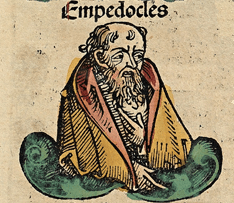
Empedocles is most famous for the concept of the four unchangeable classical elements; solid earth, liquid water, gaseous air, and glowing, consuming fire. These were probably understood of as tiny, subsensible, particles or corpuscles – the first such conception. This became the mainstream dogma for more or less the next two thousand years.
It must be noted however, that these corpuscles did not conform with modern theories of elements or atoms, for it is not known whether:
- They differed qualitatively from each other;
- Their diversity was finite or infinite;
- Similar corpuscles were quantitatively equal;
- They were capable of continued division;
- Or, whether they can affect each others state, and if so, in what manner.
Empedocles also understood that two forces – of love and hate (a unity of opposites) – enables all transformation and change. The contention between the two enables life.
Empedocles (born 490 B.C. in Agrigent) was a personality in whose soul the old and the new modes of conception clash as in a violent antagonism. He still feels something of the old mode of being in which the soul was more closely interwoven with external existence. Hatred and love, antipathy and sympathy live in the human soul. They also live outside the wall that encloses it. The life of the soul is thus homogeneously extended beyond its boundaries and it appears in forces that separate and connect the elements of external nature — air, fire, water and earth — thereby causing what the senses perceive in the outer world.
Empedocles is, as it were, confronted with nature, which appears to the senses to be deprived of life and soul, and he develops a soul mood that revolts against this extirpation of nature’s animation. His soul cannot believe that nature really is what thought wants to make of it. Least of all can it admit that it should stand in such a relation to nature as it appears according to the intellectual world conception. We must imagine what goes on in a soul that senses such a discord in all its harshness, suffering from it. We shall then be capable of entering into the experience of how, in this soul of Empedocles, the old mode of conception is resurrected as the power of intimate feeling but is unwilling to raise this fact into full consciousness. It thus seeks a form of existence in a shade of experience hovering between thought and picture that is reechoed in the sayings of Empedocles. These lose their strangeness if they are understood in this way. The following aphorism is attributed to him. “Farewell. A mortal no longer, but an immortal god I wander about . . . and as soon as I come into the flourishing cities I am worshipped by men and women. They follow me by the thousands, seeking the path of their salvation with me, some expecting prophecies, others, curative charms for many diseases.”
In such a way, a soul that is haunted by an old form of consciousness through which it feels its own existence as that of a banished god who is cast out of another form of existence into the soul-deprived world of the senses, is dazed. He therefore feels the earth to be an “unaccustomed place” into which he is cast as in punishment. There are certainly other sentiments also to be found in the soul of Empedocles because significant flashes of wisdom shine in his aphorisms. His feeling with respect to the “birth of the intellectual world conception” is characterised, however, by the thought mood mentioned above.
Rudolf Steiner, Riddles of Philosophy.

Like almost all of the Presocratic philosophers before them, we have only inherited tiny fragments of their writings – mostly from later philosophers, building on, or criticising their works. This makes an understanding of what Leucippus and Democrites understood particularly challenging. The only name given to these corpuscles which has survived is that of atom, meaning uncuttable.
Apparently the form (rhythm, shape) of the individual corpuscles, and the relations between them, enabled an account of their Ideal being. The resemblance to Plato’s Ideal forms, as described in his Timaeus, is striking. Both the relations between them, as well as of their movement, depended on the mysterious void, which enabled observation of their physical appearance and behaviour.
An individual corpuscle may therefore be considered as a non-material entity, but when they come together, with the assistance of void, they may form material objects, accessible to our senses. The void, when thought of as the emptiness of space between objects, enabled movement, but also change and decay. The nature of the void as conceived of by the Pre-Socratics is highly disputed by modern scholars. To the Ancient Greeks, Chaos meant emptiness, void, chasm, abyss. It was negative in all meanings of the word. It is related to the English word gap, as in the famous “mind the gap” regularly announced on the London Underground. To Pherecydes, Chaos, had some of the properties of air or water; formless, but differentiable. It was associated with the imperfections of the physical world we inhabit. For Parmenides it was associated with the Way of Mortals (also called the Way of Seeming), which concerned itself which knowledge of the material world. To the Greeks, void was such an inconceivable thing, their number system had no symbol for zero, nought, nothing. It has been said that Plato disliked Democritus so much that he desired for all of his books to be burned.
The thinkers who are called the atomists regarded what nature had become for the soul of man through the birth of thought in a different way. The most important among them is Democritus (born 460 B.C. in Abdera). Leucippus is a kind of forerunner to him.
With Democritus, the homoiomeries of Anaxagoras have become, to a considerable degree, more material. In Anaxagoras, one can still compare the entities of the basic parts with living germs. With Democritus, they become dead indivisible particles of matter, which in their different combinations make up the things of the outer world. They mix freely as they move to and fro; thus, the events of nature come to pass. The world reason (nous) of Anaxagoras, which has the world processes grow out of the combined action of the homoiomeries like a spiritual (incorporeal) consciousness, with Democritus, turns into the unconscious law of nature (ananke). The soul is ready to recognise only what it can grasp as the result of simple thought combinations. Nature is now completely deprived of life and soul; thought has paled as a soul experience into the inner shadow of inanimate nature. In this way, with Democritus, the intellectual prototype of all more or less materialistically coloured world conceptions of later times has made its appearance.
The atom world of Democritus represents an external world, a nature in which no trace of soul life can be found. The thought experiences in the soul, through which the soul has become aware of itself, are mere shadow experiences in Democritus. Thus, a part of the fate of thought experiences is characterised. They bring the human soul to the consciousness of its own being, but they fill it at the same time with uncertainty about itself. The soul experiences itself in itself through thought, but it can at the same time feel that it lost its anchorage in the independent spiritual world power that used to lend it security and inner stability. This emancipation of the soul was felt by the group of men in Greek intellectual life known as “Sophists.” The most important among them is Protagoras of Abdera (480 – 410 B.C.).
Rudolf Steiner, Riddles of Philosophy.

 Rethinking the Nature of Substance
Leave a reply to Ancient Greek Insights – Rethinking the Nature of Substance Cancel reply