
The story of the atom is a long and complex one. Their existence was hypothesised largely because they were easy to imagine and even easier to mathematize – as easy as one, two, three! They were generally considered to be very small, solid and like billiard balls in their collisions. Some believed that they possessed different shapes or colours to account for the different substances they were presumed to form. Whilst many natural philosophers (scientists) believed they were solid forms surrounded by an empty void, others believed that they swirled around and were able to interpenetrate each other, such that there was no need of that frightening concept – void. In the seventeenth century Leibniz believed they were entities which he called monads, but Newton believed they were corpuscles. And they all produced very complex and clever reasons for why their ideas were correct. However, they all agreed on one thing – that the atom – whatever it was; it was invisible.
I give here a short introduction to the subject taken from Wikipedia [slightly edited for my purposes]:
Atomic theory
In chemistry and physics, atomic theory is a scientific theory of the nature of matter, which states that matter is composed of discrete units called atoms. It began as a philosophical concept in ancient Greece and entered the scientific mainstream in the early 19th century when discoveries in the field of chemistry showed that matter did indeed behave as if it were made up of atoms.
The word atom comes from the Ancient Greek adjective atomos, meaning “indivisible”.[1] 19th century chemists began using the term in connection with the growing number of irreducible chemical elements. Around the turn of the 20th century, through various experiments with electromagnetism and radioactivity, physicists discovered that the so-called “uncuttable atom” was actually a conglomerate of various subatomic particles (chiefly, electrons, protons and neutrons) which can exist separately from each other.
Since atoms were found to be divisible, physicists later invented the term “elementary particles” to describe the “uncuttable”, though not indestructible, parts of an atom. The field of science which studies subatomic particles is particle physics, and it is in this field that physicists hope to discover the true fundamental nature of matter.
History
Philosophical atomism
Main article: Atomism
The idea that matter is made up of discrete units is a very old idea, appearing in many ancient cultures such as Greece and India. The word “atom” (Greek: ἄτομος; atomos), meaning “uncuttable”, was coined by the Pre-Socratic Greek philosophers Leucippus and his pupil Democritus (c. 460 – c. 370 BC).[2][3][4][5] Democritus taught that atoms were infinite in number, uncreated, and eternal, and that the qualities of an object result from the kind of atoms that compose it.[3][4][5] Democritus’s atomism was refined and elaborated by the later Greek philosopher Epicurus (341 – 270 BC), and by the Roman Epicurean poet Lucretius (c. 99 – c. 55 BC).[4][5] During the Early Middle Ages, atomism was mostly forgotten in western Europe.[4] During the 12th century, atomism became known again in western Europe through references to it in the newly-rediscovered writings of Aristotle.[4]
In the 14th century, the rediscovery of major works describing atomist teachings, including Lucretius’s De rerum natura and Diogenes Laërtius‘s Lives and Opinions of Eminent Philosophers, led to increased scholarly attention on the subject.[4] Nonetheless, because atomism was associated with the philosophy of Epicureanism, which contradicted orthodox Christian teachings, belief in atoms was not considered acceptable by most European philosophers.[4] The French Catholic priest Pierre Gassendi (1592 – 1655) revived Epicurean atomism with modifications, arguing that atoms were created by God and, though extremely numerous, are not infinite.[4][5] Gassendi’s modified theory of atoms was popularised in France by the physician François Bernier (1620 – 1688) and in England by the natural philosopher Walter Charleton (1619 – 1707).[4] The chemist Robert Boyle (1627 – 1691) and the physicist Isaac Newton (1642 – 1727) both defended atomism and, by the end of the 17th century, it had become accepted by portions of the scientific community.[4]
John Dalton
Near the end of the 18th century, two laws about chemical reactions emerged without referring to the notion of an atomic theory. The first was the law of conservation of mass, closely associated with the work of Antoine Lavoisier, which states that the total mass in a chemical reaction remains constant (that is, the reactants have the same mass as the products).[6] The second was the law of definite proportions. First established by the French chemist Joseph Louis Proust in 1799,[7] this law states that if a compound is broken down into its constituent chemical elements, then the masses of the constituents will always have the same proportions by weight, regardless of the quantity or source of the original substance.
John Dalton studied and expanded upon this previous work and defended a new idea, later known as the law of multiple proportions: if the same two elements can be combined to form a number of different compounds, then the ratios of the masses of the two elements in their various compounds will be represented by small whole numbers. This is a common pattern in chemical reactions that was observed by Dalton and other chemists at the time. Dalton himself discovered that oxygen will combine with a certain amount of nitrous gas to form nitric acid, or twice that amount to form nitrous acid — a ratio of 1:2.[8] Joseph Proust discovered that 100 parts of iron will combine with either 28 or 42 parts of oxygen[a][9][10] (a ratio of 2:3); and that 119 parts of tin will combine with either 16 or 32 parts of oxygen[11] (a ratio of 1:2). Dalton found that an atomic theory of matter could elegantly explain this pattern, as well as Proust’s law of definite proportions. In the case of Proust’s tin oxides, one tin atom will combine with either one or two oxygen atoms to form either the first or the second oxide of tin.[12]
Dalton believed atomic theory could also explain why water absorbed different gases in different proportions – for example, he found that water absorbed carbon dioxide far better than it absorbed nitrogen.[13] Dalton hypothesised this was due to the differences in mass and complexity of the gases’ respective particles. Indeed, carbon dioxide molecules (CO2) are heavier and larger than nitrogen molecules (N2).
Dalton proposed that each chemical element is composed of atoms of a single, unique type, and though they cannot be altered or destroyed by chemical means, they can combine to form more complex structures (chemical compounds). This marked the first truly scientific theory of the atom, since Dalton reached his conclusions by experimentation and examination of the results in an empirical fashion.
In 1803 Dalton orally presented his first list of relative atomic weights for a number of substances. This paper was published in 1805, but he did not discuss there exactly how he obtained these figures.[13] The method was first revealed in 1807 by his acquaintance Thomas Thomson, in the third edition of Thomson’s textbook, A System of Chemistry. Finally, Dalton published a full account in his own textbook, A New System of Chemical Philosophy, 1808 and 1810.
Dalton estimated the atomic weights according to the mass ratios in which they combined, with the hydrogen atom taken as unity. However, Dalton did not conceive that with some elements atoms exist as molecules — e.g. pure oxygen exists as O2. He also mistakenly believed that the simplest compound between any two elements is always one atom of each (so he thought water was HO, not H2O).[14] This, in addition to the crudity of his equipment, flawed his results. For instance, in 1803 he believed that oxygen atoms were 5.5 times heavier than hydrogen atoms, because in water he measured 5.5 grams of oxygen for every 1 gram of hydrogen and believed the formula for water was HO. Adopting better data, in 1806 he concluded that the atomic weight of oxygen must actually be 7 rather than 5.5, and he retained this weight for the rest of his life. Others at this time had already concluded that the oxygen atom must weigh 8 relative to hydrogen, which equals 1, if one assumes Dalton’s formula for the water molecule (HO), or 16 if one assumes the modern water formula (H2O).[15]
Avogadro
The flaw in Dalton’s theory was corrected in principle in 1811 by Amedeo Avogadro. Avogadro had proposed that equal volumes of any two gases, at equal temperature and pressure, contain equal numbers of molecules (in other words, the mass of a gas’s particles does not affect the volume that it occupies).[16] Avogadro’s law allowed him to deduce the diatomic nature of numerous gases by studying the volumes at which they reacted. For instance: since two litres of hydrogen will react with just one litre of oxygen to produce two litres of water vapour (at constant pressure and temperature), it meant a single oxygen molecule splits in two in order to form two particles of water. Thus, Avogadro was able to offer more accurate estimates of the atomic mass of oxygen and various other elements, and made a clear distinction between molecules and atoms.
Brownian Motion
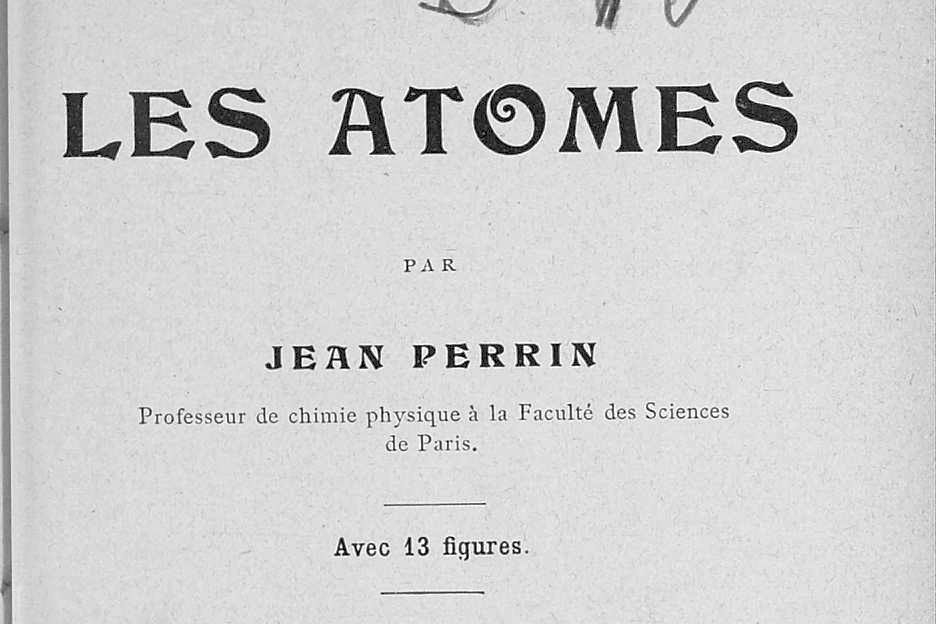
In 1827, the British botanist Robert Brown observed that dust particles inside pollen grains floating in water constantly jiggled about for no apparent reason. In 1905, Albert Einstein theorised that this Brownian motion was caused by the water molecules continuously knocking the grains about, and developed a hypothetical mathematical model to describe it.[17] This model was validated experimentally in 1908 by French physicist Jean Perrin, thus providing additional validation for particle theory (and by extension atomic theory).
Ordinarily I would include information about the use of the hypothetical nineteenth century atom to produce the kinetic theory of heat. However it is possible that this may not be required since this book is not about chemistry or physics in general, nor is it about heat in particular. [Indications for an alternative approach to this subject were given by Rudolf Steiner in his Warmth Course.]
It was not until the work of Einstein and Perrin on Brownian motion that the last of the mainstream objectors to the concept of the atom – the chemist Ostwald in particular – accepted its existence as a sub-sensible entity. Nevertheless, the mysterious nature of this invisible entity at this time was only just beginning to reveal itself.

 Rethinking the Nature of Substance
Leave a reply to Table of Contents – Rethinking the Nature of Substance Cancel reply