
Biodynamics and the Taming of the Materialistic Lion
How Plato & Aristotle, Goethe & Steiner,
Herzeele, Holleman & Vysotskii, Adams & Thomas
may have changed our understanding of
life, chemical substance and nuclear transmutation.
-
By the 1840s mainstream scientists appear to have concluded that living organisms obey the same physical and chemical laws as inorganic nature. During the course of the nineteenth century their experiments increasingly supported this belief. However, some noteworthy exceptions existed.…
-
[Old] Chapter 2: The End of Vitalism [New Ch.8 V0.2.1]
This chapter will be about how the old conception of a life force, with the development of scientific thinking, died. It will probably cover much of the subject matter contained in the Wikipedia article – Vitalism…
-
[Old] Chapter 1: The Origins of Chemistry
The mysteries to be explored in this book largely fall under the subject matter of chemistry. Though I was not particularly talented at school or university in the practical art of chemistry, I have always been fascinated by its magical…
-
[Old] Foreword: The Story So Far!
The original book concept was big and ambitious. I tried to simplify it. But each of its parts increasingly appeared to form a single coherent whole. So I am now in the challenging process of bringing all of its parts…
-
Space and Counterspace – by Nick Thomas
This was Nick Thomas’s second book to explore his challenging work to develop a mathematical science based on the spiritual indications of Rudolf Steiner. This book was written as more of an introductory work. It is therefore a little easier…
-
Space and Counterspace – by Nick Thomas – Ch.1 – Part 6 – Heisenberg & Goethe
By way of further support for the importance of qualia in scientific endeavour, Nick Thomas refers us, in his fourteenth paragraph, to the authority of Werner Heisenberg. …
-
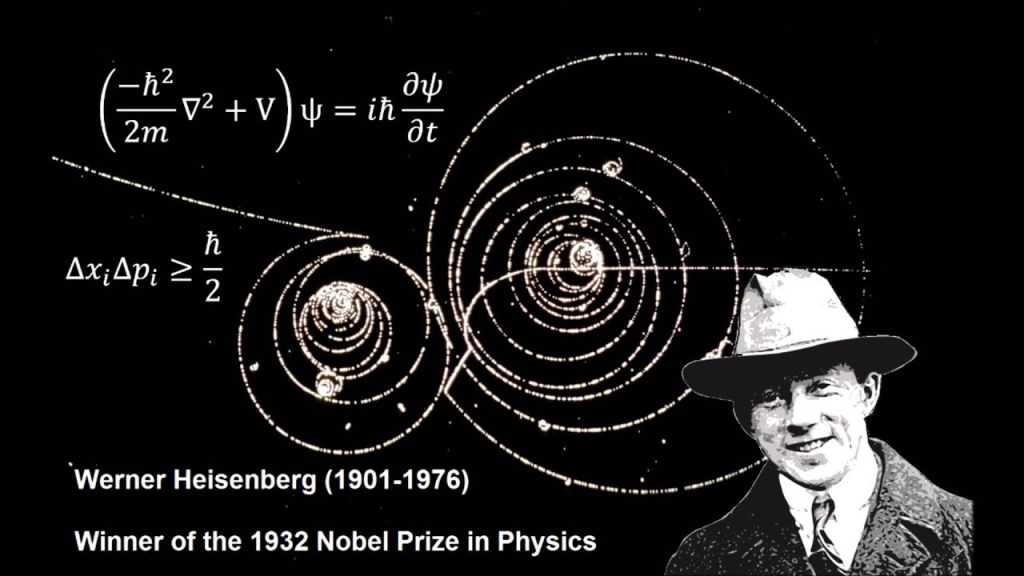
Heisenberg on Goethe
I have been aware of Werner Heisenberg’s respect for Goethe the scientist for some time, so was very happy to discover his 1952 lectures on “Philosophic Problems of Nuclear Science”. I give below a verbatim copy of the text of…
-
Space and Counterspace – by Nick Thomas – Ch.1 – Part 5 – Parallelism
In his sixth to twelfth paragraphs Nick Thomas gives detailed examples based on our experience of colour, compared with a physicist’s handling of colour. I give his examples verbatim…
-
Space and Counterspace – by Nick Thomas – Ch.1 – Part 4 – Understanding
Continuing on to Nick Thomas’ fifth paragraph, here he emphasises the importance of an understanding of qualia, a word used to identify each of our experiences of, or in response to the world. The most elementary of these arise from…
-
Space and Counterspace – by Nick Thomas – Ch.1 – Part 3 – Contingencies
Let me start with a summary in my own words of Thomas’ previous paragraph. In this he showed that all science is ultimately based on human experience. Let me give an example of my own here…
 Rethinking the Nature of Substance