
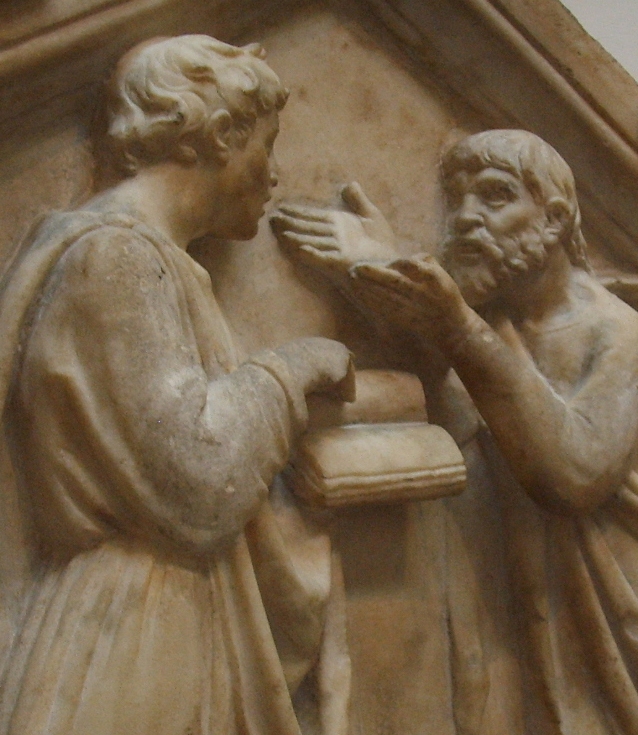
This is very much a work in progress. All of these definitions are provisional and will be worked on and improved during the writing of the book. Feedback on the definitions would be especially welcome.
Dialectic and logic
Communication and explanation. [See Joe Sachs on dialectic as described by Plato and Aristotle. See also logos…]
- Categories
- Aristotle‘s ten categories. Rudolf Steiner described them as the cosmic alphabet. … See; https://wn.rsarchive.org/RelArtic/BobbetteRSW/steineraz_1908.html; https://wn.rsarchive.org/GA/GA0233a/19240422p01.html and Ernst Marti…
- See Chapter 2.
- Thinghood: Ousia has variously been translated as, substance, being, existence. It is not the thing itself, but the Ideal (see idea) properties of that thing. [See Sachs’ Metaphysics book]
- Quantity: Poson, or how much. This can include the physical size or weight of a thing, or the number of individual things. It is at the heart of academic physics and related so-called objective, quantitative sciences. See Chapters …
- Quality: Poion, of what kind or quality. It is at the heart of personal experience, Goethean Science and phenomenology. A unit of experience has been called a quale.
- Relations: Pros ti, towards something. Whether something is bigger than, or nearer to something else.
- Place: Pou, where – a physical thing’s location relative to a particular known something else – in the market-place, or on the table.
- Time: Pote, when – a physical thing’s relative position in the course of events – yesterday, last year. See Chapter 2 for details.
- Being in a position: Keisthei, posture or attitude. A posture, such as lying down, is not a thing-in-itself but a property of a body – a-thing-existing-in-a-lying-down-position. It is most likely only applied to describe animals or human beings. (Hall 2019: pp. 10-11).
- Having: Echein, to be by continuing or holding on in some effortful or active way (a state or condition). (Sachs 2002).
- Acting: Poiein, to make or do.
- Being acted upon: Paschein, to suffer or undergo. These last two complement each other, what Goethe called “deeds and sufferings“.
- Mathematics
- I have placed mathematics under the heading of dialectic and logic because I consider mathematics to be a language with which we can engage with and communicate the patterns formed in all realms of nature, both sensible (see knowledge, percept) and super-sensible (see knowledge, concept). This does not mean that I consider mathematics to be a branch of formal logic. See metaphysics for: Arithmetic; Geometry; Kinematics.
- Truth;
- There are several philosophical accounts of what truth is.
- The correspondence theory is that truth is when one’s account corresponds with what people have perceived, which have been called objective facts.
- The coherence theory of truth is that truth is when one’s ideas are logically coherent.
- There are several philosophical accounts of what truth is.
 Rethinking the Nature of Substance