| This website is under reconstruction! Please be patient. The book is in the process of being researched, reviewed and written. – The Table of Contents – The Home page – links via either the image or the title at the top of the page – contain all my current and previous drafts, thoughts and notes. |
| I am sad to say that I have chosen to replace my early drafts of prehistoric and Ancient Greek history almost in their entirety with a new and hopefully more relevant narrative. This replacement concentrates on the possibly controversial idea of Plato’s Philosopher, who provides a direct link to Goethe and Steiner’s worldview. My guidance is provided by the highly respected writings of Mary Louise Gill, with help from the writings of Joe Sachs. My intention is to facilitate an understanding of a worldview that is bigger than I can manage to write about in a single volume. Therefore some elements, however precious, will inevitably get left out in order for a balanced picture to be created in as few brush strokes as possible. However, these old writings do contain much that may possibly be of interest both to myself as well as others and – who knows – some of its content may find a new home in one way or another. Also of possible interest is that it records my surprise discovery that these early Greek philosophers agreed with each other far more than most of the literature about them might suggest. The key was the beginnings of an understanding of the Ancient Greek concepts of doxa and logos used by Parmenides and Heraclitus. At best one creates doxa or personal opinions from sense perceptions – experiences that belong only to that individual. One can only create a logos, a verbal account, using words drawn from concepts seen with the mind and shared with others. Ideas are eternal – shown to Parmenides by the Goddess Aletheia, Truth or perhaps better translated as Revelation, the existence of which are very much independent of us mortals. |
Classical Antiquity and Atomism
Technological innovations may have been developed by this time, but their conception was not seen as we do today. They were not created or understood by means of abstract thought, but through imaginative (creative, but exact) thought pictures [Riddles of Philosophy, Rudolf Steiner]. However, from the time of Homer, and the advent of written Greek, humankind began to feel separate from the world of Gods and elemental beings. As Steiner said: “Their thought pictures developed as a tool of truth“.
Pherecydes

Some consider the first Greek philosopher to have been Pherecydes. In his world conception everything was constituted through the actions of three Ideas (divine beings); Chronos, Chthon and Zeus.
[Footnote: Realists – such as the Ancient Greeks, Goethe, Steiner, and some twentieth century phenomenologists – believe(d) that ideas are entities which can be seen with our minds – that they have an existence independent of our minds. Unfortunately our own personal mental pictures are also called ideas – fuzzy representations of true ideas. To distinguish between the two, a true Idea is often written with a capital ‘I‘ – a custom I choose to follow here.
Steiner and the Ancient Greeks also believed that spiritual (divine) beings are entities which may be seen with our minds – they believed that all Ideas are divine beings. Rain, roses, naturally occurring copper, even man-made materials such as bronze – the essence or Idea of every entity – are all divine beings. And sensory qualities such as smoothness, reflectiveness, redness – everything and anything one can possibly experience – the Ancient Greeks believed they were all divine beings, seen with our minds.]
Of Pherecedes’ writings, only fragments survive, though others have written about his ideas. [Footnote: Except he would have understood that they were not his ideas. He had merely developed the ability to see them, along with the ability to find the words to communicate what he understood. In English we still say, when we understand something; ‘I see‘.]
According to Rudolf Steiner, in his Riddles of Philosophy, Pherecydes wrote of Chronos – the divine being of time – but not in the modern sense of measured clock time. Chronos was a being with the qualities or essence of time; it devours Chthon, a being with the qualities of earth, of the solid element. “Chronos lives in the activity of fire or warmth.” Again, this is not actual fire – as it is sensually experienced – it is the consuming activity of fire, of warmth, which is Chronos.
Zeus (or Zas), Steiner associated with the dissolving of water from liquid to vapour, and of clouds of vapour when they dissolve into the air. This is the action of spatially spreading or even the force of centrifugal extension (the etheric force as conceived of by Steiner).
Chthon (Chthonie) – Pherecydes’ third being – Steiner wrote that it was seen in the action of water becoming solid, or solid becoming fluid.
These three beings were seen as being interdependent. It is only through Zeus that Chronos consumes Chthon. [Footnote: It is worth pausing here and thinking about these beings – of their individual and collective natures. The threefold nature of the cosmos may be understood from their deeds and sufferings.]
In the view of Pherekydes the world is constituted through the cooperation of these three principles. Through the combination of their action the material world of sense perception — fire, air, water and earth — come into being on the one hand, and on the other, a certain number of invisible supersensible spirit beings who animate the four material worlds. Zeus, Chronos and Chthon could be referred to as “spirit, soul and matter,” but their significance is only approximated by these terms. It is only through the fusion of these three original beings that the more material realms of the world of fire, air, water and earth, and the more soul-like and spirit-like (supersensible) beings come into existence. Using expressions of later world conceptions, one can call Zeus, space-ether; Chronos, time-creator; Chthon, matter-producer — the three “mothers of the world’s origin.” We can still catch a glimpse of them in Goethe’s Faust, in the scene of the second part where Faust sets out on his journey to the “mothers.”
Rudolf Steiner, Riddles of Philosophy.
As Ideal qualities, Pherecydes’ three mothers were perfect, and represented what was (later known?) as the good (agathos). However, in the imperfections of the sensible world Pherecydes saw another being – Ophioneus – an agent of chaos.
Whoever sees the world only as it presents itself to image perception does not, at first, distinguish in his thought between the events of the “good mothers” and those of Ophioneus. At the borderline of a thought-formed world conception, the necessity of this distinction is felt, for only at this stage of progress does the soul feel itself to be a separate, independent entity. It feels the necessity to ask what its origin is. It must find its origin in the depths of the world where Chronos, Zeus and Chthon had not as yet found their antagonists. But the soul also feels that it cannot know anything of its own origin at first, because it sees itself in the midst of a world in which the “Mothers” work in conjunction with Ophioneus. It feels itself in a world in which the perfect and the imperfect are joined together. Ophioneus is twisted into the soul’s own being.
We can feel what went on in the souls of individual personalities of the sixth century B.C. if we allow the feelings described here to make a sufficient impression on us. With the ancient mythical deities such souls felt themselves woven into the imperfect world. The deities belonged to the same imperfect world as they did themselves.
Rudolf Steiner, Riddles of Philosophy.
Pythagoras
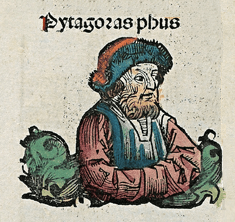
Pythagoras was said by some to have been a student of Pherecydes. He is famous for founding a spiritual brotherhood based on a belief that ‘the whole of the heavens is harmony and number‘ and that ‘all things are numbers‘ [Aristotle’s Metaphysics, cited by Dijksterhuis, The Mechanization of the World Picture]. This belief in the power of number had great consequences, by way of those whose ideas were influenced by Pythagoras and his disciples; these included Plato and Aristotle. [Aristotle’s Metaphysics, cited by Dijksterhuis, The Mechanization of the World Picture.]
The spiritual brotherhood, which was founded by Pythagoras of Samos between the years 549 and 500 B.C. in Kroton in Magna Graecia, grew out of such a mood. Pythagoras intended to lead his followers back to the experience of the “Primordial Mothers” in which the origin of their souls was to be seen. It can be said in this respect that he and his disciples meant to serve “other gods” than those of the people. With this fact something was given that must appear as a break between spirits like Pythagoras and the people, who were satisfied with their gods. Pythagoras considered these gods as belonging to the realm of the imperfect. In this difference we also find the reason for the “secret” that is often referred to in connection with Pythagoras and that was not to be betrayed to the uninitiated… In what other form than in a brotherhood with a strictly regulated mode of life could the souls become aware of their lofty origin and still find themselves deeply bound up with imperfection? It was just through this feeling of deficiency that the effort was to be made to arrange life in such a way that through the process of self-perfection it would be led back to its origin.
…
Let us think of Pythagoras as standing before the beginning of intellectual world conception. He saw how thought took its origin in the soul that had, starting from the “mothers,” descended through its successive lives to its state of imperfection; Because he felt this he could not mean to ascend to the origins through mere thought. He had to seek the highest knowledge in a sphere in which thought was not yet at home. There he found a life of the soul that was beyond thought life. As the soul experiences proportional numbers in the sound of music, so Pythagoras developed a soul life in which he knew himself as living in a connection with the world that can be intellectually expressed in terms of numbers. But for what is thus experienced, these numbers have no other significance than the physicist’s proportional tone numbers have for the experience of music.
For Pythagoras the mythical gods must be replaced by thought. At the same time, he develops an appropriate deepening of the soul life; the soul, which through thought has separated itself from the world, finds itself at one with the world again. It experiences itself as not separated from the world. This does not take place in a region in which the world-participating experience turns into a mythical picture, but in a region in which the soul reverberates with the invisible, sensually imperceptible cosmic harmonies. It brings into awareness, not its own thought intentions, but what cosmic powers exert as their will, thus allowing it to become conception in the soul of man.
In Pherekydes and Pythagoras the process of how thought-experienced world conception originates in the human soul is revealed. Working themselves free from the older forms of conception, these men arrive at an inwardly independent conception of the “soul” distinct from external “nature.” What is clearly apparent in these two personalities — the process in which the soul wrests its way out of the old picture conceptions — takes place more in the undercurrents of the souls of the other thinkers with whom it is customary to begin the account of the development of Greek philosophy. The thinkers who are ordinarily mentioned first are Thales of Miletos (640 – 550 B.C.), Anaximander (born 610 B.C.), Anaximenes (flourished 600 B.C.) and Heraclitus (born 500 B.C. at Ephesus).
Rudolf Steiner, Riddles of Philosophy.
Thales
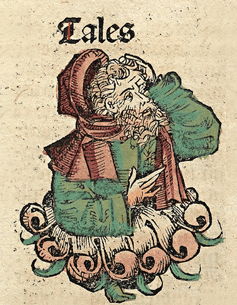
Thales most famously stated that the fundamental origin and being of all things was to be found in “water”. He was a contemporary of Pherecydes, and he founded the Milesian school, which introduced a conception of nature in terms of observable entities.
Anaximander
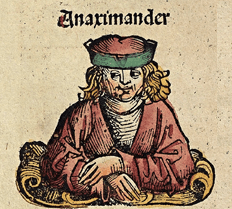
Anaximander most famously stated that the fundamental origin and being of all things was to be found in the “infinite” (apeiron). He was taught by Thales and became the second master of the Milesian school.
Anaximenes
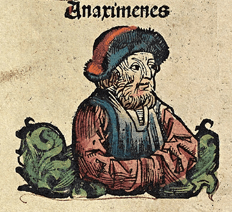
Anaximenes stated that the fundamental and origin and being of all things was to be found in “air”. He was either a younger friend or student of Anaximander at the Milesian school, and was the last of the renowned Milesian philosophers.
Heraclitus
[Heraclitus spoke vigorously against Homer, Hesiod and the scholars of his day. He wished to point out the manner of their thought which clings only to the transitory. He did not want the gods furnished with attributes taken from the transitory world. And he could not respect as the highest a science which investigated the laws of the growth and decay of things. — For him the eternal speaks through the transitory. He has a deeply significant symbol for this eternal: “The harmony of the world is of opposite tensions, as is that of the lyre or bow.” [Fragment 56 c.f. Fragment 45] How much is contained in this pictured Unity is attained by the striving of forces in opposite directions and the harmonization of these diverging forces. One tone contradicts another, yet together they achieve harmony. If we apply this to the spiritual world we have the thought of Heraclitus: “Immortals take on mortality, mortals immortality; death is the eternal life of mortals, earthly life the death of immortals.” [Fragment 67] Steiner – Christianity as Mystical Fact, Chapter 3.]
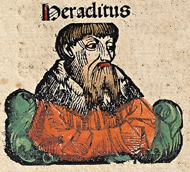
Heraclitus stated that the fundamental origin and being of all things was to be found in “fire”. Like Thales, Anaximander and Anaximenes before him, he was from the Ionian school (of which the Melesian school had been a part). They were collectively called the physiologoi (those who discoursed on nature) by Aristotle.
What is not considered in this treatment is the fact that these men are still really living in the process of the genesis of intellectual world conception. To be sure, they feel the independence of the human soul in a higher degree than Pherekydes, but they have not yet completed the strict separation of the life of the soul from the process of nature. One will, for instance, most certainly construct an erroneous picture of Thales’s way of thinking if it is imagined that he, as a merchant, mathematician and astronomer, thought about natural events and then, in an imperfect yet similar way to that of a modern scientist, had summed up his results in the sentence, “Everything originates from water.” To be a mathematician or an astronomer, etc., in those ancient times meant to deal in a practical way with the things of these professions, much in the way a craftsman makes use of technical skills rather than intellectual and scientific knowledge.
What must be presumed for a man like Thales is that he still experienced the external processes of nature as similar to inner soul processes. What presented itself to him like a natural event, as did the process and nature of “water” (the fluid, mudlike, earth-formative element), he experienced in a way that was similar to what he felt within himself in soul and body. He then experienced in himself and outside in nature the effect of water, although to a lesser degree than man of earlier times did. Both effects were for him the manifestation of one power. It may be pointed out that at a still later age the external effects in nature were thought of as being akin to the inner processes in a way that did not provide for a “soul” in the present sense as distinct from the body. Even in the time of intellectual world conception, the idea of the temperaments still preserves this point of view as a reminiscence of earlier times.
One called the melancholic temperament, the earthy; the phlegmatic, the watery; the sanguinic, the airy; the choleric, the fiery. [Footnote: See the Wikipedia entry for a general introduction to the four temperaments.] These are not merely allegorical expressions. One did not feel a completely separated soul element, but experienced in oneself a soul-body entity as a unity. In this unity was felt the stream of forces that go, for instance, through a phlegmatic soul, to be like the forces in external nature that are experienced in the effects of water. One saw these external water effects to be the same as what the soul experienced in a phlegmatic mood. The thought habits of today must attempt an empathy with the old modes of conception if they want to penetrate into the soul life of earlier times.
In this way one will find in the world conception of Thales an expression of what his soul life, which was akin to the phlegmatic temperament, caused him to experience inwardly. He experienced in himself what appeared to him to be the world mystery of water. The… phlegmatic temperament, when it is combined with an energetic, objective imagination, makes a sage out of a man because of its calmness, collectedness and freedom from passion. Such a disposition in Thales probably caused him to be celebrated by the Greeks as one of their wise men.
For Anaximenes, the world picture formed itself in another way. He experienced in himself the sanguine temperament. A word of his has been handed down to us that immediately shows how he felt the air element as an expression of the world mystery. “As our soul, which is a breath, holds us together, so air and breath envelop the universe.”
The world conception of Heraclitus will, in an unbiased contemplation, be felt directly as a manifestation of his choleric inner life. A member of one of the most noble families of Ephesus, he became a violent antagonist of the democratic party because he had arrived at certain views, the truth of which was apparent to him in his immediate inner experience. The views of those around him, compared with his own, seemed to him to prove directly in a most natural way, the foolishness of his environment. Thus, he got into such conflicts that he left his native city and led a solitary life at the Temple of Artemis. Consider these few of his sayings that have come down to us. “It would be good if the Ephesians hanged themselves as soon as they grew up and surrendered their city to those under age.” Or the one about men, “Fools in their lack of understanding, even if they hear the truth, are like the deaf: of them does the saying bear witness that they are absent when present.”
The feeling that is expressed in such a choleric temperament finds itself akin to the consuming activity of fire. It does not live in the restful calm of “being.” It feels itself as one with eternal “becoming.” Such a soul feels stationary existence to be an absurdity. “Everything flows,” is, therefore, a famous saying of Heraclitus. It is only apparently so if somewhere an unchanging being seems to be given. We are lending expression to a feeling of Heraclitus if we say, “The rock seems to represent an absolute unchanging state of being, but this is only appearance; it is inwardly in the wildest commotion; all its parts act upon one another.” The mode of thinking of Heraclitus is usually characterised by his saying, “One cannot twice enter the same stream, for the second time the water is not the same.”…
We do not consider a world conception in its full significance if we accept only its thought content. Its essential element lies in the mood it communicates to the soul, that is, in the vital force that grows out of it. One must realise how Heraclitus feels himself with his own soul in the stream of becoming. The world soul pulsates in his own human soul and communicates to it of its own life as long as the human soul knows itself as living in it. Out of such a feeling of union with the world soul, the thought originates in Heraclitus, “Whatever lives has death in itself through the stream of becoming that is running through everything, but death again has life in itself. Life and death are in our living and dying. Everything has everything else in itself; only thus can eternal becoming flow through everything.” “The ocean is the purest and impurest water, drinkable and wholesome to fishes, to men undrinkable and pernicious.” “Life and death are the same, waking and sleeping, young and old; the first changes into the second and again into the first.” “Good and evil are one.” “The straight path and the crooked… are one.” [Footnote: Such seemingly paradoxical expressions are of polarities. Heraclitus gives a number of examples of two polar extremes—opposites—but since such opposites are defined by each other, their ideal essences must—by necessity—contain each other; they are two parts of a single whole. A polarity must not be confused with a duality; the latter requires no necessary connection between its two parts. For more details see Chapter 15: Goethe’s Worldview.]
Anaximander is freer from the inner life, more surrendered to the element of thought itself. He sees the origin of things in a kind of world ether, an indefinite formless basic entity that has no limits. Take the Zeus of Pherekydes, deprive him of every image content that he still possesses and you have the original principle of Anaximander: Zeus turned into thought. A personality appears in Anaximander in whom thought life is borne out of the mood of soul that still has, in the preceding thinkers, the colour of temperament. Such a personality feels united as a soul with the life of thought, and thereby is not so intimately interwoven with nature as the soul that does not yet experience thought as an independent element. It feels itself connected with a world order that lies above the events of nature. When Anaximander says that men lived first as fishes in the moist element and then developed through land animal forms, he means that the spirit germ, which man recognises through thinking as his true being, has gone through the other forms only as through preliminary stages, with the aim of giving itself eventually the shape that has been appropriate for him from the beginning. [Footnote: In modern terms one might consider this as a spiritual morphogenesis. For more on this see the chapter on Goethe.]
Rudolf Steiner, Riddles of Philosophy.
Following on from this is an account of the journey made by the Ancient Greeks in which they slowly gained the ability to separate:
- Percepts—‘images’ gained from the physical senses—the basis of practical experience (known to the Greeks as doxa—true opinions)—and;
- Concepts—ideas ‘seen’ by the mind—the basis of (Ideal) knowledge (logos);
The heights of their progress are to be seen in the works of the historically misunderstood Plato and Aristotle. Their understanding of the nature of substance, of matter, and of change is important to this book. I wish to show how, contrary to most studies of the Ancient Greek philosophers, each of their natural philosophical ideas—of doxa and logos—all form parts of a greater, largely coherent, whole. This whole being none other than that of the nature of reality. [Footnote: This idea, that the combination of percept and concept gives knowledge of reality, was the subject matter of Steiner’s PhD Thesis—published as ‘Truth and Knowledge’. Plato’s dialogue ‘Theaetetus’, on knowledge, tentatively draws the same conclusion—knowledge (of reality) is a doxa combined with a logos. Since the real world is the real world, why should I be surprised to observe that Ancient Greek philosophers studying the real world wrote about things—which when taken together—form a broadly coherent whole; collectively they agreed with each other! How could it have been any other way unless they were deluded fantasists. They differ only because of the different perspectives they took when making their observations, and the imagery they chose with which to clothe their knowledge.]
Parmenides and Zeno
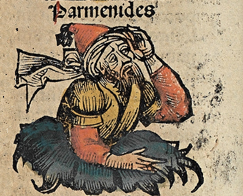
The Eleatic school of philosophers was most likely founded by Parmenides. He was most famous for stating that the “All is One”. The predecessor of his ideas was Xenophanes.
The thought element is already alive to such a degree in these thinkers that they demand a world conception in which the life of thought is fully satisfied; they recognise truth only in this form. How must the world ground be constituted so that it can be fully absorbed within thinking? This is their question.
Xenophanes finds that the popular gods cannot stand the test of thought; therefore, he rejects them. His god must be capable of being thought. What the senses perceive is changeable, is burdened with qualities not appropriate to thought, whose function it is to seek what is permanent. Therefore, God is the unchangeable, eternal unity of all things to be seized in thought.
Rudolf Steiner, Riddles of Philosophy.
Like Xenophanes, Parmenides rejected sensory experience as a source of truth. Truth is eternal, but material objects are subject to change and decay. The (Ideal) being of a material object is that which is eternal. That which is eternal cannot have a beginning or an end. It only ‘is‘.
| Existence, (the quality of) being, isness – all different words for a philosophically challenging concept associated with the Greek word ‘is‘. My own understanding is based on my studies of Goethe’s world view, as interpreted by Rudolf Steiner and Henri Bortoft. Consider a material object – my own favourite example is an individual rose bush. It exists – it has (an Ideal) being – it is. All rose bushes have the same is-ness. That is-ness is its non-material essence. It is Ideal, spiritual. It is a part of all existence, of universal being. All being is part of a unified whole. All is One. |
Parmenides expressed these ideas in a three part poem, On Nature, in the form of the earliest known logical argument.
The poem was in three parts:
- A proem (preface), which introduced the entire work,
- “The Way of Truth” (aletheia), and
- “The Way of Appearance/Opinion” (doxa).
The subject matter of the poem as a whole is central to the philosophical ideas developed by Plato in his theory of (Ideal) forms – of which more later. Parmenides, in this poem, demonstrated three things:
- The power of his own thinking to see Ideas which he said were shown to him by a divine being;
- His ability to communicate these ideas to others, and;
- His ability to demonstrate their truth by means of logical argument (“the art of thinking”).
What follows is “The Way of Truth”, which he later contrasts with “The Way of Seeming”, which has also been translated as “The Way of Mortal Belief”. The first part was concerned with the way to spiritual understanding (if we take the meaning of the word spiritual in the sense of the German word Geist, which means mental activity – and therefore includes thinking). Through our thinking we may see Ideal truths – which are timeless, and therefore immortal – as were his Gods.
The ‘Way of Seeming’ (which has also been translated as ‘The Way of Mortal Belief’) relates to the physical world, which we see with our physical senses. Physical entities—including our own physical bodies—are prone to change and decay—they are mortal. As mere physical mortals we may be limited to our personal beliefs. However—by means of our thinking—we may travel at least part of the way along the path to the realm(s) of immortal truth. Almost nothing has survived of this last part of the poem, just hints. But what has survived suggests that Parmenides “provided a complete cosmological theory, explaining the physical world and its processes … The scientific and causal theories … seem to be thorough and advanced. They include theses about psychology, embryology, and astronomy.” However, Parmenides continually warns against such knowledge. An empirical science is based on practical knowledge, mortal opinion (doxa): “in which there is no true trust.” [Footnote: Osborne (2004).]
His pupil Zeno of Elea c. 495–c. 430 BC wholeheartedly promoted ‘The Way of Truth’ to the exclusion of knowledge gained from our physical senses, our ‘common sense’. They are clever paradoxes—perhaps too clever. The most famous—Achilles and the Tortoise—is still argued over by philosophers and mathematicians today. The importance of his work for us is his consideration of the nature of space or time being infinitely divisible. [Footnote: This is of importance in, for example, the next section.]
Rudolf Steiner in Chapter 5 of his Philosophy of Freedom showed how only when a concept (the subject of Parmenides’ Way of Truth) is combined with a percept (the subject of Parminedes’ Way of Seeming) is a true picture of reality formed of the whole thing. [Though, Parmenedes and Heraclitus both have fragments in common – see Short Intro to Pre-Socratics] Unfortunately we may never know exactly what Parmenides wrote, for only fragments of his book survive. However, it is clear that his pupil Zeno wholeheartedly promoted “The Way of Truth” to the exclusion of knowledge gained from our physical senses.
Anaxagoras
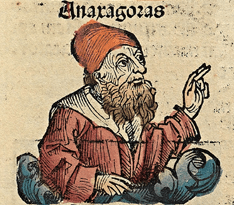
Anaxagoras (c. 510–c. 428 BC) was the first of the so called atomists. They primarily concerned themselves with the nature of material objects and their transformations. Though the Eleatics, who preceded them, concerned themselves with the Ideal realm of being, the atomists also respected their ideas:
The Greeks do not think correctly about coming-to-be and passing-away; for no thing comes to be or passes away, but [their being] is mixed together and dissociated from the things that are. And thus they would be correct to call coming-to-be being mixed together and passing-away being dissociated.
Anaxagoras (DK 59 B17), cited by Stanford Encyclopedia of Philosophy.
Also, from an anonymous critic:
When Anaxagoras discovered the old belief that nothing comes from that which is not in any way whatsoever, he did away with coming-to-be, and introduced dissociation in place of coming-to-be. For he foolishly said that all things are mixed with each other, but that as they grow they are dissociated. For in the same seminal fluid there are hair, nails, veins and arteries, sinew, and bone, and it happens that they are imperceptible because of the smallness of the parts, but when they grow, they gradually are separated off. “For how,” he says, “can hair come from what is not hair, and flesh from what is not flesh?” He maintained this, not only about bodies, but also about colours. For he said that black is in white and white in black. And he laid down the same thing with respect to weights, believing that light is mixed with heavy and vice versa.
(DK 59 B10); from the anonymous scholiast on a 4th c. C.E. work of Gregory of Nazianzus, cited by Stanford Encyclopedia of Philosophy.
Such a view is clearly holistic in nature. Only when thought of as shades of grey does the idea that white contains black, and black contains white become obvious. From this perspective black and white are polarities, not dualities. The amount of black in pure white may be infinitesimally small – so small as to be mere potential – but that potential is not nothing. Since Parmenides showed that All is One, all things may have potential existence in everything else. The entities of potential existence, Anaxagoras called homoiomeries. [Footnote: See also the section on Heraclitus above.]
Nor of the small is there a smallest, but always a smaller (for what-is cannot not be) — but also of the large there is always a larger. And [the large] is equal to the small in extent (plêthos), but in relation to itself each thing is both large and small.
Since the shares of the large and the small are equal in number, in this way too, all things will be in everything; nor is it possible that [anything] be separate, but all things have a share of everything. Since it is not possible that there is a least, it would not be possible that [anything] be separated, nor come to be by itself, but just as in the beginning, now too all things are together.
Fragments B3 & B6 of Anaxagoras: cited by Stanford Encyclopedia of Philosophy.
This is the first of the so-called atomic theories. However, it would be better to call this a corpuscular conception, for these homoeomeries were described as being infinitely divisible. [Footnote: The original definition of an atom is that which is uncuttable (indivisible).]
Steiner completes this story of Anaxagoras:
Whoever does not see how, in the progress of human development toward the stage of thought experience, real experiences — the picture experiences — came to an end with the beginning of this thought life, will not see the special quality of the Greek thinkers from the sixth to the fourth pre-Christian centuries in the light in which they must appear in this presentation. Thought formed a wall around the human soul, so to speak. The soul had formerly felt as if it were within the phenomena of nature. What it experienced in these natural phenomena, like the activities of its own body, presents itself to the soul in the form of images that appeared in vivid reality. Through the power of thought this entire panorama was now extinguished. Where previously images saturated in content prevailed, thought now expanded through the external world. The soul could experience itself in the surroundings of space and time only if it united itself with thought.
One senses such a mood of soul in Anaxagoras of Clazomenae in Asia Minor (born 500 B.C.). He found himself deeply bound up in his soul with thought life. His thought life encompassed what is extended in space and time. Expanded like this, it appears as the nous, the world reason. It penetrates the whole of nature as an entity. Nature, however, presents itself as composed only of little basic entities. The events of nature that result from the combined actions of these fundamental entities are what the senses perceive after the texture of imagery has vanished from nature. These fundamental entities are called homoiomeries. The soul experiences in thought the connection with the world reason (the nous) inside its wall. Through the windows of the senses it watches what the world reason causes to come into being through the action of the homoiomeries on each other.
Rudolf Steiner, Riddles of Philosophy.
Empedocles
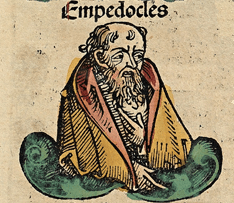
Empedocles was famous for having established the doctrine of the four elements—elemental qualities: earth, water, air and fire. These imperceptible entities (corpuscles, not atoms) interacted with each other under the influence of the forces of love (philia) and strife (Neikos) to produce the physical phenomena of the sense perceptible world. We are fortunate that the more fragments of his work survive than for other Presocratics. [Osborne (2004).] A give here a relatively free translation of his most famous—and for us, most important—fragment:
A double tale I will tell:
Once they grew as One from
Many — another time again they grew
To be Many from this One —
Double is this their mortal birth
Double the destruction of mortal life —
For first the convergence of all
Begets and destroys one living round
And then the dispersal of all
Begets and destroys another turn round
And these never cease dialectically turning
All coming together because of Love
All driven apart again by Strife —
So as One arises from Many
And Many come together in One
Thus there is becoming and no
Abiding — but as there is also
No end to their turning — what
Does not change is endless changing.

But come — listen—learning increases wisdom
As already told here I tell
A double tale — at one time
They grew One alone from Many
Another time again they split into
Many from being One — Fire and
Water and Earth and expansive Air
And catastrophic Strife apart from them
Balanced in every way — and Love —
Too — equal in length and breadth:
Gaze upon her with your mind —
Do not sit with dazzled eyes
She is said to be inborn
In bodies of men — by her
Convivial thoughts flow and collective labours
Are accomplished — naming her Joy and
Aphrodite whom no mortal has seen
Whirling amongst them — listen close to
These words — they do not deceive.

All these [elements] are equal and
Of the same age but each
Has its own domain and ethos
Prevailing in turn as time rounds
And nothing else comes into being
Or ceases to be — for continual
Destruction would leave nothing left and
What could add to this totality?
And where would it come from?
Perishing into what would it pass
Since there is nothing outside these?
No — only these exist and passing
Through each other they become different
Things at different times — yet ever
And always they remain the same.

(Love and Strife) A free translation of Empedocles Fragment 17,
by Stephen Collis.
A number of things can be said here. In an earlier fragment the elements are directly assigned to four Gods:
- Zeus—Air or aether;
- Hera—Earth;
- Aidoneus (Hades)—Fire;
- Nestis (Persephone)—Water.
Also:
- Aphrodite—Love
- Neikos—Strife
The exact attributions are the subject of debate, and fortunately need not concern us here, [Footnote: See, for example, Rowett (2016). Her thesis is that Empedocles’ poem is not about mechanistic chemistry or physics. It may in fact be about agency, marriage and sex.] but what is clear from this is that these elements and forces are spiritual (non-material). Therefore, when love (sympathy) and strife (antipathy) are given the qualities of equal length and breadth, we must not fall into the trap of saying, as others have done, that if they possess extension in space they must therefore be material entities. Here Empedocles, is clothing these non-material entities in imagery borrowed from the material world.[Footnote: The only realm we can draw physical imagery from is the material world: In Western Christian paintings, God is conventionally portrayed as an elderly bearded white European, sitting in a toga and sandals on a cloud in the sky! In modern physics textbooks, atoms are portrayed as solid billiard balls! It is essential we are able to separate such pictures from the realities that they represent. This has been a major problem throughout history, and still is today.] Presumably he wishes to say that they are equal but opposite in their influences. [Footnote: Vlastos, Gregory (1993) ‘Studies in Greek Philosophy: The Presocratics’, Princeton University Press, New Jersey. p.62.]
In his references to the One and the Many, he is clearly referring to Parmenides. His poem explores the twofold polarities of love and strife, One and Many, spiritual and material, immortal and mortal, and (if Rowett (2016) is correct), air (aether) and earth (levity and gravity) and between fire and water (the Hades and Persephone story is well known). The poem is clearly about relationships—I leave it up to the reader to explore further the possibilities of this work.
- https://wn.rsarchive.org/GA/GA0139/19120921p01.html – The Gospel of St. Mark:
- “Underlying everything visible in the world is a trinity: Chronos, Zeus and Chthon. From Chronos comes the airy, the fiery and the watery element. Ophioneus, a kind of serpent being, comes into conflict with all that stems from these three powers.”
- “Chronos is put forward not merely as abstract passing time but as a real being in a perceptible form. It is the same with Zeus, the limitless ether, as a living self-perpetuating being; while Chthon, who draws down to earth what once was heavenly, draws together into the planet earth all that is woven in space, in order to make earthly existence possible. All this happens on earth. Then a kind of serpent being interferes, and introduces, so to speak, a hostile element.”
- “He sees behind the sense world to the real causes … He sees the living weaving of the good gods and how hostile powers interfere in their work; … He sees how the elements are born out of Chronos, out of Time seen as a real being.”
- “Now let us think of one of the other souls who cannot see how the elements are born in a living way out of Chronos. It is unable to see how Ophioneus, the serpent-being, enters into conflict with the higher gods, but it is able to glimpse that something is at work in the physical material world. It cannot see through to Chronos, but it sees the imprint of Chronos in the world of sense, in fire, water, air and earth. It is not able to see how the higher gods are opposed by the lower gods, and how Lucifer, the serpent-god, rebels; but it does see how harmony and disharmony, friendship and enmity prevail. It sees love and hate as abstract concepts, and fire, water, air, and earth as abstract elements.”
- “Let us think of such a soul still standing within the livingness of the earlier era, but unable to see into the spiritual world, able only to grasp its external counterpart, a soul which because of its special mission found that what had previously brought bliss to human beings was hidden from it. Yet this soul has nothing from the new world of the ego save a few concepts to which it feels obliged to cling. What we have before us is the soul of Empedocles. If we wish to comprehend the inner being of such a soul, then it is the soul of Empedocles that stands before us. Empedocles is almost a contemporary of the sage of Syros; he lives scarcely two-thirds of a century later. But his soul is constituted quite differently. It had the task of crossing the Rubicon that separated the old clairvoyance from the abstract comprehension of the ego. We see here two worlds suddenly clashing with one another. Here we see the dawning of the ego and how it advances toward its fulfilment.”
Empedocles (born 490 B.C. in Agrigent) was a personality in whose soul the old and the new modes of conception clash as in a violent antagonism. He still feels something of the old mode of being in which the soul was more closely interwoven with external existence. Hatred and love, antipathy and sympathy live in the human soul. They also live outside the wall that encloses it. The life of the soul is thus homogeneously extended beyond its boundaries and it appears in forces that separate and connect the elements of external nature — air, fire, water and earth — thereby causing what the senses perceive in the outer world.
Empedocles is, as it were, confronted with nature, which appears to the senses to be deprived of life and soul, and he develops a soul mood that revolts against this extirpation of nature’s animation. His soul cannot believe that nature really is what thought wants to make of it. Least of all can it admit that it should stand in such a relation to nature as it appears according to the intellectual world conception. We must imagine what goes on in a soul that senses such a discord in all its harshness, suffering from it. We shall then be capable of entering into the experience of how, in this soul of Empedocles, the old mode of conception is resurrected as the power of intimate feeling but is unwilling to raise this fact into full consciousness. It thus seeks a form of existence in a shade of experience hovering between thought and picture that is reechoed in the sayings of Empedocles. These lose their strangeness if they are understood in this way. The following aphorism is attributed to him. “Farewell. A mortal no longer, but an immortal god I wander about . . . and as soon as I come into the flourishing cities I am worshipped by men and women. They follow me by the thousands, seeking the path of their salvation with me, some expecting prophecies, others, curative charms for many diseases.”
In such a way, a soul that is haunted by an old form of consciousness through which it feels its own existence as that of a banished god who is cast out of another form of existence into the soul-deprived world of the senses, is dazed. He therefore feels the earth to be an “unaccustomed place” into which he is cast as in punishment. There are certainly other sentiments also to be found in the soul of Empedocles because significant flashes of wisdom shine in his aphorisms. His feeling with respect to the “birth of the intellectual world conception” is characterised, however, by the thought mood mentioned above.
Rudolf Steiner, Riddles of Philosophy.
Democritus

Like almost all of the Presocratic philosophers before them, we have only inherited tiny fragments of the writings of Leucippus (? 5th century BC) and Democritus (c. 460–c. 370 BC)—mostly from later philosophers, building on, or criticising their works. This makes an understanding of what they understood particularly challenging. The only name given to these corpuscles which has survived is that of atom, meaning uncuttable.
Apparently the form (rhythm, shape) of the individual corpuscles, and the relations between them, enabled an account of their Ideal being. The resemblance to Plato’s Ideal forms, as described in his Timaeus, is striking. [Footnote required.] Both the relations between them, as well as of their movement, depended on the mysterious void, which enabled observation of their physical appearance and behaviour.
An individual corpuscle may therefore be considered as a non-material entity, but when they come together, with the assistance of void, they may form material objects, accessible to our senses. The void, when thought of as the emptiness of space between objects, enabled movement, but also change and decay. The nature of the void as conceived of by the Pre-Socratics is highly disputed by modern scholars. To the Ancient Greeks, Chaos meant emptiness, void, chasm, abyss. It was negative in all meanings of the word. It is related to the English word gap, as in the famous “mind the gap” regularly announced on the London Underground. To Pherecydes, Chaos had some of the properties of air or water; formless, but differentiable. It was associated with the imperfections of the physical world we inhabit. For Parmenides it was associated with the Way of Mortals (also called the Way of Seeming), which concerned itself which knowledge of the material world. To the Greeks, void was such an inconceivable thing, their number system had no symbol for zero, nought, nothing. It has been said that Plato disliked Democritus so much that he desired for all of his books to be burned.
The thinkers who are called the atomists regarded what nature had become for the soul of man through the birth of thought in a different way. The most important among them is Democritus (born 460 B.C. in Abdera). Leucippus is a kind of forerunner to him.
With Democritus, the homoiomeries of Anaxagoras have become, to a considerable degree, more material. In Anaxagoras, one can still compare the entities of the basic parts with living germs. With Democritus, they become dead indivisible particles of matter, which in their different combinations make up the things of the outer world. They mix freely as they move to and fro; thus, the events of nature come to pass. The world reason (nous) of Anaxagoras, which has the world processes grow out of the combined action of the homoiomeries like a spiritual (incorporeal) consciousness, with Democritus, turns into the unconscious law of nature (ananke). The soul is ready to recognise only what it can grasp as the result of simple thought combinations. Nature is now completely deprived of life and soul; thought has paled as a soul experience into the inner shadow of inanimate nature. In this way, with Democritus, the intellectual prototype of all more or less materialistically coloured world conceptions of later times has made its appearance.
The atom world of Democritus represents an external world, a nature in which no trace of soul life can be found. The thought experiences in the soul, through which the soul has become aware of itself, are mere shadow experiences in Democritus. Thus, a part of the fate of thought experiences is characterized. They bring the human soul to the consciousness of its own being, but they fill it at the same time with uncertainty about itself. The soul experiences itself in itself through thought, but it can at the same time feel that it lost its anchorage in the independent spiritual world power that used to lend it security and inner stability. This emancipation of the soul was felt by the group of men in Greek intellectual life known as “Sophists.” The most important among them is Protagoras of Abdera (480 – 410 B.C.).
Rudolf Steiner, Riddles of Philosophy.
The Sophists
The next philosophical movement to emerge in 5th century Ancient Greece were the sophists.
The sophists are often presented as men who superficially played with their thinking… It is noteworthy that even Socrates, who to a certain limited extent thought of himself as a pupil of Prodicus, is said to have described him as a man who had done much for the refinement of the speech and thinking of his disciples.
Protagoras’s view is expressed in the famous statement, “Man is the measure of all things, of those that are, that they are; of those that are not, that they are not.” In the sentiment underlying this statement the thought experience feels itself sovereign. It does not sense any connection with an objective world power. If Parmenides is of the opinion that the senses supply man with a world of deception, one could go further and add, “Why should not thinking, although one experiences it, also deceive?” Protagoras, however, would reply to this, “Why should it be man’s concern if the world outside him is not as he perceives and thinks it? Does he imagine it for anyone else but himself? No matter how it may be for another being, this should be of no concern to man. The contents of his mind are only to serve him; with their aid he is to find his way through the world. Once he achieves complete clarity about himself, he cannot wish for any thought contents about the world except those that serve him.” Protagoras means to be able to build on thinking. For this purpose he intends to have it rest exclusively on its own sovereign power… Thus, they were to develop thought in the soul into a world conception…
From Pherekydes (or Thales) to the sophists, one can observe how emaciated thought in Greece, which had already been born before these men, gradually finds its place in the stream of philosophical development. The effect thought has when it is placed in the service of world conception becomes apparent in them. The birth of thought, however, is to be observed in the entire Greek life. One could show much the same kind of development in the fields of art, poetry, public life, the various crafts and trades, and one would see everywhere how human activity changes under the influence of the form of human organisation that introduces thought into the world conception. It is not correct to say that philosophy “discovers” thought. It comes into existence through the fact that the newly born thought life is used for the construction of a world picture that formerly had been formed out of experiences of a different kind.
Rudolf Steiner, Riddles of Philosophy.
Socrates
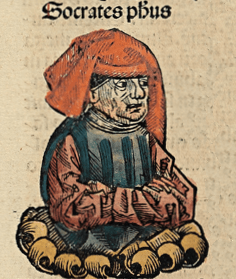
Socrates, though he wrote nothing himself, has been considered one of the founders of Western philosophy. He is only known of from later writers, such as Plato.
While the sophists led the spirit of Greece, expressed in the motto, “Know Thyself,” to the edge of a dangerous cliff, Socrates, who was born in Athens about 470 and was condemned to death through poison in 399 B.C., expressed this spirit with a high degree of perfection.
Historically, the picture of Socrates has come down to us through two channels of tradition. In one, we have the figure that his great disciple, Plato (427 – 347 B.C.), has drawn of him. Plato presents his philosophy in dialogue form, and Socrates appears in these dialogues as a teacher. He is shown as the “sage” who leads the persons around him through intellectual guidance to high stages of insight. A second picture has been drawn by Xenophon in his Memorabilia of Socrates. At first sight it seems as if Plato had idealised the character of Socrates and as if Xenophon had portrayed him more directly as he had been. But a more intimate inspection would likely show that both Plato and Xenophon each drew a picture of Socrates as they saw him from a special point of view…
…Both Plato and Xenophon present Socrates in such a way that in him his personal opinion speaks everywhere. This personality carries in itself the awareness that, whoever expresses his personal opinion out of the true ground of the soul, expresses something that is more than just human opinion, something that is a manifestation of the purposes of the world order through human thinking. By those who think they know him, Socrates is taken as the living proof for the conviction that truth is revealed in the human soul through thinking if, as was the case with Socrates, this soul is grounded in its own substance. Looking on Socrates, Plato does not teach a doctrine that is asserted by contemplative thought, but the thought has a rightly developed human being speak, who then observes what he produces as truth…
Through the attitude Plato takes with respect to Socrates, the resulting answer is that in the human soul the reason of the world speaks what it intends to reveal to man…
…Thought speaks to the inner soul. With thought, therefore, the soul is left to its own resources; it cannot feel united with another soul as with the revelations of a priestly oracle. To thought, one had to lend one’s own soul. One felt of thought that it was a common possession of all men.
…He experienced the “daimonion” in himself, the spiritual force that leads the soul. Thought has brought the soul to the consciousness of itself. With his conception of the daimonion speaking in him that, always leading him, told him what to do, Socrates meant to say, “The soul that has found its way to the thought life is justified to feel as if it communicated in itself with the world reason. It is an expression of the high valuation of what the soul possesses in its thought experience.”
…True virtue must be found in thought life because it is from thought life that man derives his value. “Virtue is teachable.” In this way is Socrates’ conception most frequently expressed. It is teachable because whoever really seizes thought life must be in its possession…
Thus, what the pre-Socratic age strove for becomes manifest in Socrates, that is, the appreciation of what humanity has been given through the awakened thought life. Socrates’ method of teaching is under the influence of this conception. He approaches man with the presupposition that thought in life is in him; it only needs to be awakened. It is for this reason that he arranges his questions in such a way that the questioned person is stimulated to awaken his own thought life. This is the substance of the Socratic method.
Rudolf Steiner, Riddles of Philosophy.
Plato and Aristotle: Understanding Reality—the Unity of Matter and Substance
The two most important Greek philosophers, who influenced the historical development of Western philosophy more than any other, were Plato and his student Aristotle. However, they were—and still are—also two of the most misunderstood. [See Henri Bortoft, p. 113.]
Plato

[Note to self: Give examples from Mary Louise Gill and Joe Sachs, i.e. dialectic method—friendly conversations; ironic nature of his texts—deliberately misleading—puzzles for his students to solve; ideal forms as a concept that goes beyond the cave allegory.]
[See https://wn.rsarchive.org/Lectures/GA074/English/PLH1932/19200523p01.html ]
Plato, who was born in Athens in 427 B.C., felt, as a disciple of Socrates, that his master had helped him to consolidate his confidence in the life of thought. What the entire previous development tended to bring into appearance reaches a climax in Plato. This is the conception that in thought life the world spirit reveals itself. The awareness of this conception sheds, to begin with, its light over all of Plato’s soul life. Nothing that man knows through the senses or otherwise has any value as long as the soul has not exposed it to the light of thought. Philosophy becomes for Plato the science of ideas as the world of true being, and the idea is the manifestation of the world spirit through the revelation of thought. The light of the world spirit shines into the soul of man and reveals itself there in the form of ideas; the human soul, in seizing the idea, unites itself with the force of the world spirit. The world that is spread in space and time is like the mass of the ocean water in which the stars are reflected, but what is real is only reflected as idea. Thus, for Plato, the whole world changes into ideas that act upon each other. Their effect in the world is produced through the fact that the ideas are reflected in hyle, the original matter. What we see as the many individual things and events comes to pass through this reflection. We need not extend knowledge to hyle, the original matter, however, for in it is no truth. We reach truth only if we strip the world picture of everything that is not idea. For Plato, the human soul is living in the idea, but this life is so constituted that the soul is not a manifestation of its life in the ideas in all its utterances. Insofar as it is submerged in the life of ideas, it appears as the “rational soul” (thought-bearing soul), and as such, the soul appears to itself when it becomes aware of itself in thought perception. It must also manifest itself in such a way that it appears as the “non-rational soul” (not-thought-bearing soul), As such, it again appears in a twofold way as courage-developing, and as appetitive soul. Thus, Plato seems to distinguish three members or parts in the human soul: The rational soul, the courage-like (or will-exertive) soul and the appetitive soul. We shall, however, describe the spirit of his conceptional approach better if we express it in a different way. According to its nature, the soul is a member of the world of ideas, but it acts in such a way that it adds an activity to its life in reason through its courage life and its appetitive life. In this threefold mode of utterance it appears as earthbound soul. It descends as a rational soul through physical birth into a terrestrial existence, and with death again enters the world of ideas. Insofar as it is rational soul, it is immortal, for as such it shares with its life the eternal existence of the world of ideas.
Rudolf Steiner, Riddles of Philosophy.
Aristotle
[Text to come.]
Ancient world
[What follows below gives a sketch of some further content, taken from (slightly modified) Wikipedia’s chemistry page. Also to be included is relevant content from Dijksterhuis, and some alchemical references.]
Around 420 BC, Empedocles stated that all matter is made up of four elemental substances: earth, fire, air and water. The early theory of atomism can be traced back to ancient Greece and ancient India.[14] Greek atomism dates back to the Greek philosopher Democritus, who declared that matter is composed of indivisible and indestructible particles called “atomos” around 380 BC. Leucippus also declared that atoms were the most indivisible part of matter. This coincided with a similar declaration by Indian philosopher Kanada in his Vaisheshika sutras around the same time period.[14] In much the same fashion he discussed the existence of gases. What Kanada declared by sutra, Democritus declared by philosophical musing. Both suffered from a lack of empirical data. Without scientific proof, the existence of atoms was easy to deny. Aristotle opposed the existence of atoms in 330 BC. Earlier, in 380 BC, a Greek text attributed to Polybus argued that the human body is composed of four humours. Around 300 BC, Epicurus postulated a universe of indestructible atoms in which man himself is responsible for achieving a balanced life.
With the goal of explaining Epicurean philosophy to a Roman audience, the Roman poet and philosopher Lucretius[15] wrote De rerum natura (The Nature of Things)[16] in 50 BC. In the work, Lucretius presents the principles of atomism; the nature of the mind and soul; explanations of sensation and thought; the development of the world and its phenomena; and explains a variety of celestial and terrestrial phenomena.
Practical Chemistry
Much of the early development of purification methods is described by Pliny the Elder in his Naturalis Historia. He tried to explain those methods, as well as making acute observations of the state of many minerals.
[See Rapp (2013: pp. 3 ff.)]
Medieval alchemy
See also: Minima naturalia, a medieval Aristotelian concept analogous to atomism
The elemental system used in medieval alchemy was developed primarily by the Persian–Arab alchemist Jābir ibn Hayyān and was rooted in the classical elements of Greek tradition.[17] His system consisted of the four Aristotelian elements of air, earth, fire, and water in addition to two philosophical elements: sulphur, characterizing the principle of combustibility, “the stone which burns”; and mercury, characterizing the principle of metallic properties. They were seen by early alchemists as idealized expressions of irreducible components of the universe[18] and are of larger consideration[clarification needed] within philosophical alchemy.
The three metallic principles (sulphur to flammability or combustion, mercury to volatility and stability, and salt to solidity) became the tria prima of the Swiss alchemist Paracelsus. He reasoned that Aristotle’s four-element theory appeared in bodies as three principles. Paracelsus saw these principles as fundamental and justified them by recourse to the description of how wood burns in fire. Mercury included the cohesive principle, so that when it left the wood (in smoke) the wood fell apart. Smoke described the volatility (the mercurial principle), the heat-giving flames described flammability (sulphur), and the remnant ash described solidity (salt).[19]
The philosopher’s stone
Alchemy is defined by the Hermetic quest for the philosopher’s stone, the study of which is steeped in symbolic mysticism, and differs greatly from modern science. Alchemists toiled to make transformations on an esoteric (spiritual) and/or exoteric (practical) level.[20] It was the protoscientific, exoteric aspects of alchemy that contributed heavily to the evolution of chemistry in Greco-Roman Egypt, in the Islamic Golden Age, and then in Europe. Alchemy and chemistry share an interest in the composition and properties of matter, and until the 18th century they were not separate disciplines. The term chymistry has been used to describe the blend of alchemy and chemistry that existed before that time.[21]
The earliest Western alchemists, who lived in the first centuries of the common era, invented chemical apparatus. The bain-marie, or water bath, is named for Mary the Jewess. Her work also gives the first descriptions of the tribikos and kerotakis.[22] Cleopatra the Alchemist described furnaces and has been credited with the invention of the alembic.[23] Later, the experimental framework established by Jabir ibn Hayyan influenced alchemists as the discipline migrated through the Islamic world, then to Europe in the 12th century CE.
During the Renaissance, exoteric alchemy remained popular in the form of Paracelsian iatrochemistry, while spiritual alchemy flourished, realigned to its Platonic, Hermetic, and Gnostic roots. Consequently, the symbolic quest for the philosopher’s stone was not superseded by scientific advances, and was still the domain of respected scientists and doctors until the early 18th century. Early modern alchemists who are renowned for their scientific contributions include Jan Baptist van Helmont, Robert Boyle, and Isaac Newton.
Alchemy in the Islamic world
In the Islamic World, the Muslims were translating the works of the ancient Greeks and Egyptians into Arabic and were experimenting with scientific ideas.[24] The development of the modern scientific method was slow and arduous, but an early scientific method for chemistry began emerging among early Muslim chemists, beginning with the 9th-century chemist Jābir ibn Hayyān (known as “Geber” in Europe), who is sometimes regarded as “the father of chemistry”.[25][26][27][28] He introduced a systematic and experimental approach to scientific research based in the laboratory, in contrast to the ancient Greek and Egyptian alchemists whose works were largely allegorical and often unintelligible.[29] He also invented and named the alembic (al-anbiq), chemically analyzed many chemical substances, composed lapidaries, distinguished between alkalis and acids, and manufactured hundreds of drugs.[30] He also refined the theory of five classical elements into the theory of seven alchemical elements after identifying mercury and sulfur as chemical elements.[31][verification needed]
 Rethinking the Nature of Substance
Leave a comment