
| This text is in a coloured box to separate it from the rest of the chapter. It is a comment about the second part of this working draft chapter, which started as a more or less conventional historical review of the early developments of chemistry in the West. The first parts of the Wikipedia page, History of Chemistry, were used as a template for this early draft. This update interweaves its content with Rudolf Steiner’s Riddles of Philosophy. Also used is E.J. Dijksterhuis, The Mechanization of the World Picture. |
The next philosophical movement to emerge in 5th century Ancient Greece were the sophists.
The sophists are often presented as men who superficially played with their thinking… It is noteworthy that even Socrates, who to a certain limited extent thought of himself as a pupil of Prodicus, is said to have described him as a man who had done much for the refinement of the speech and thinking of his disciples.
Protagoras’s view is expressed in the famous statement, “Man is the measure of all things, of those that are, that they are; of those that are not, that they are not.” In the sentiment underlying this statement the thought experience feels itself sovereign. It does not sense any connection with an objective world power. If Parmenides is of the opinion that the senses supply man with a world of deception, one could go further and add, “Why should not thinking, although one experiences it, also deceive?” Protagoras, however, would reply to this, “Why should it be man’s concern if the world outside him is not as he perceives and thinks it? Does he imagine it for anyone else but himself? No matter how it may be for another being, this should be of no concern to man. The contents of his mind are only to serve him; with their aid he is to find his way through the world. Once he achieves complete clarity about himself, he cannot wish for any thought contents about the world except those that serve him.” Protagoras means to be able to build on thinking. For this purpose he intends to have it rest exclusively on its own sovereign power… Thus, they were to develop thought in the soul into a world conception…
From Pherekydes (or Thales) to the sophists, one can observe how emaciated thought in Greece, which had already been born before these men, gradually finds its place in the stream of philosophical development. The effect thought has when it is placed in the service of world conception becomes apparent in them. The birth of thought, however, is to be observed in the entire Greek life. One could show much the same kind of development in the fields of art, poetry, public life, the various crafts and trades, and one would see everywhere how human activity changes under the influence of the form of human organisation that introduces thought into the world conception. It is not correct to say that philosophy “discovers” thought. It comes into existence through the fact that the newly born thought life is used for the construction of a world picture that formerly had been formed out of experiences of a different kind.
Rudolf Steiner, Riddles of Philosophy.
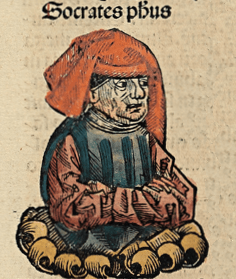
Socrates, though he wrote nothing himself, has been considered one of the founders of Western philosophy. He is only known of from later writers, such as Plato.
While the sophists led the spirit of Greece, expressed in the motto, “Know Thyself,” to the edge of a dangerous cliff, Socrates, who was born in Athens about 470 and was condemned to death through poison in 399 B.C., expressed this spirit with a high degree of perfection.
Historically, the picture of Socrates has come down to us through two channels of tradition. In one, we have the figure that his great disciple, Plato (427 – 347 B.C.), has drawn of him. Plato presents his philosophy in dialogue form, and Socrates appears in these dialogues as a teacher. He is shown as the “sage” who leads the persons around him through intellectual guidance to high stages of insight. A second picture has been drawn by Xenophon in his Memorabilia of Socrates. At first sight it seems as if Plato had idealised the character of Socrates and as if Xenophon had portrayed him more directly as he had been. But a more intimate inspection would likely show that both Plato and Xenophon each drew a picture of Socrates as they saw him from a special point of view…
…Both Plato and Xenophon present Socrates in such a way that in him his personal opinion speaks everywhere. This personality carries in itself the awareness that, whoever expresses his personal opinion out of the true ground of the soul, expresses something that is more than just human opinion, something that is a manifestation of the purposes of the world order through human thinking. By those who think they know him, Socrates is taken as the living proof for the conviction that truth is revealed in the human soul through thinking if, as was the case with Socrates, this soul is grounded in its own substance. Looking on Socrates, Plato does not teach a doctrine that is asserted by contemplative thought, but the thought has a rightly developed human being speak, who then observes what he produces as truth…
Through the attitude Plato takes with respect to Socrates, the resulting answer is that in the human soul the reason of the world speaks what it intends to reveal to man…
…Thought speaks to the inner soul. With thought, therefore, the soul is left to its own resources; it cannot feel united with another soul as with the revelations of a priestly oracle. To thought, one had to lend one’s own soul. One felt of thought that it was a common possession of all men.
…He experienced the “daimonion” in himself, the spiritual force that leads the soul. Thought has brought the soul to the consciousness of itself. With his conception of the daimonion speaking in him that, always leading him, told him what to do, Socrates meant to say, “The soul that has found its way to the thought life is justified to feel as if it communicated in itself with the world reason. It is an expression of the high valuation of what the soul possesses in its thought experience.”
…True virtue must be found in thought life because it is from thought life that man derives his value. “Virtue is teachable.” In this way is Socrates’ conception most frequently expressed. It is teachable because whoever really seizes thought life must be in its possession…
Thus, what the pre-Socratic age strove for becomes manifest in Socrates, that is, the appreciation of what humanity has been given through the awakened thought life. Socrates’ method of teaching is under the influence of this conception. He approaches man with the presupposition that thought in life is in him; it only needs to be awakened. It is for this reason that he arranges his questions in such a way that the questioned person is stimulated to awaken his own thought life. This is the substance of the Socratic method.
Rudolf Steiner, Riddles of Philosophy.

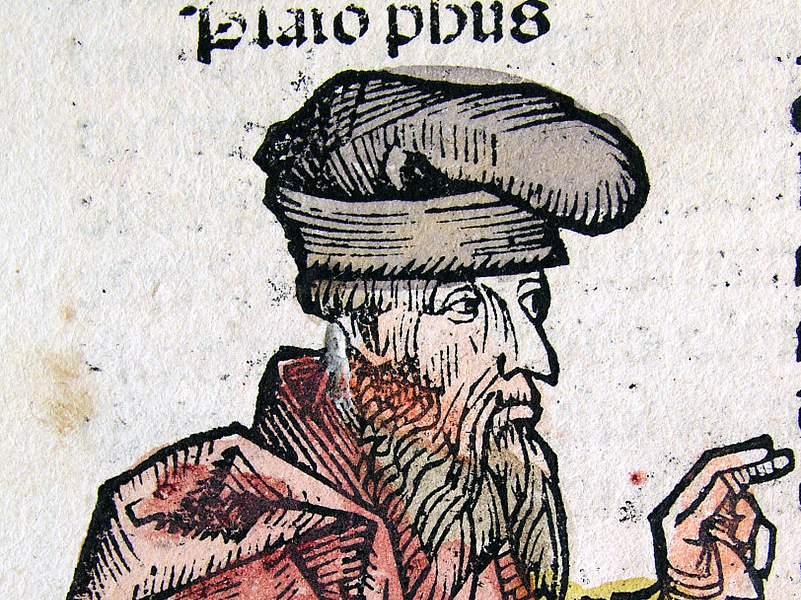
The two most important Greek philosophers, who influenced the historical development of Western philosophy more than any other, were Plato and his student Aristotle. However, they were – and still are – also two of the most misunderstood. [See Henri Bortoft, p. 113]
Though more is known of Plato’s philosophy than his predecessors
Plato, who was born in Athens in 427 B.C., felt, as a disciple of Socrates, that his master had helped him to consolidate his confidence in the life of thought. What the entire previous development tended to bring into appearance reaches a climax in Plato. This is the conception that in thought life the world spirit reveals itself. The awareness of this conception sheds, to begin with, its light over all of Plato’s soul life. Nothing that man knows through the senses or otherwise has any value as long as the soul has not exposed it to the light of thought. Philosophy becomes for Plato the science of ideas as the world of true being, and the idea is the manifestation of the world spirit through the revelation of thought. The light of the world spirit shines into the soul of man and reveals itself there in the form of ideas; the human soul, in seizing the idea, unites itself with the force of the world spirit. The world that is spread in space and time is like the mass of the ocean water in which the stars are reflected, but what is real is only reflected as idea. Thus, for Plato, the whole world changes into ideas that act upon each other. Their effect in the world is produced through the fact that the ideas are reflected in hyle, the original matter. What we see as the many individual things and events comes to pass through this reflection. We need not extend knowledge to hyle, the original matter, however, for in it is no truth. We reach truth only if we strip the world picture of everything that is not idea. For Plato, the human soul is living in the idea, but this life is so constituted that the soul is not a manifestation of its life in the ideas in all its utterances. Insofar as it is submerged in the life of ideas, it appears as the “rational soul” (thought-bearing soul), and as such, the soul appears to itself when it becomes aware of itself in thought perception. It must also manifest itself in such a way that it appears as the “non-rational soul” (not-thought-bearing soul), As such, it again appears in a twofold way as courage-developing, and as appetitive soul. Thus, Plato seems to distinguish three members or parts in the human soul: The rational soul, the courage-like (or will-exertive) soul and the appetitive soul. We shall, however, describe the spirit of his conceptional approach better if we express it in a different way. According to its nature, the soul is a member of the world of ideas, but it acts in such a way that it adds an activity to its life in reason through its courage life and its appetitive life. In this threefold mode of utterance it appears as earthbound soul. It descends as a rational soul through physical birth into a terrestrial existence, and with death again enters the world of ideas. Insofar as it is rational soul, it is immortal, for as such it shares with its life the eternal existence of the world of ideas.
Ancient world
Aristotle opposed the existence of atoms in 330 BC. Earlier, in 380 BC, a Greek text attributed to Polybus argued that the human body is composed of four humours. Around 300 BC, Epicurus postulated a universe of indestructible atoms in which man himself is responsible for achieving a balanced life.
With the goal of explaining Epicurean philosophy to a Roman audience, the Roman poet and philosopher Lucretius[15] wrote De rerum natura (The Nature of Things)[16] in 50 BC. In the work, Lucretius presents the principles of atomism; the nature of the mind and soul; explanations of sensation and thought; the development of the world and its phenomena; and explains a variety of celestial and terrestrial phenomena.
Much of the early development of purification methods is described by Pliny the Elder in his Naturalis Historia. He tried to explain those methods, as well as making acute observations of the state of many minerals.

 Rethinking the Nature of Substance
Leave a comment