
Beware of Greeks bearing gifts
I am getting bogged down with my first chapter. It largely covers Ancient Greek philosophical insights into many of the important matters that are to be explored in later chapters of this book. Every single one of these philosophers (at least the most significant figures up to and including Aristotle) appear to have been struggling to communicate one or more aspects of one and the same idea – the same idea that Steiner demonstrated was the foundation of Goethe’s holistic world conception. But I know of no one else who has spotted this insight!
But I am not writing a story about the conceptions of the Ancient Greeks. So the question I need to ask is: Just how important were they to this book? I have a strong feeling – at present not much more than that – that they are. But I also have another feeling that perhaps I am just getting side-tracked!!
A university lecturer once said to me – I think too much! But just sometimes, my thinking bears rare but wonderful fruits. Is this such an occasion?
To Begin at the Beginning…
Let me outline a thread through some of my thoughts and progress – perhaps it might shine light on which direction I might best take:
- Many years ago a friend asked me to read a book by Kervran on the biological transmutation of chemical elements – I read it and considered it nonsense.
- Seven years later I was asked by Sophia Holleman to translate and complete the unfinished report by her father Wim Holleman on his research into biological transmutation – I agreed for I was by then more open minded, though still sceptical.
- My previous academic training at university covered all the sciences in at least my foundation year – maths, chemistry, biochemistry, physics, biology – I later specialised in general biology and bio-physics. This gave me an excellent background to attempt an understanding of this challenging phenomenon.
- Meanwhile I started exploring the philosophical and scientific ideas of Rudolf Steiner and Johann Wolfgang von Goethe;
- Holleman believed that a Goethean scientific approach might bear fruit as a methodology for further investigation.
- However, at that time even the most convincing transmutation experiments were extremely limited – both in the quality of the experiments and/or the quality of the results;
- Holleman felt that even his positive results needed replication before they were worthy of publication.
- The Holleman Stichting succeeded in raising some limited funding for Jean-Paul Biberian to conduct some extremely limited transmutation experiments with a marine bacteria;
- His results were completely unexpected – even more so than Holleman’s!
- The turning point for me was my invitation to the 2004 ICCF-11 ( 11th International Cold Fusion) Conference;
- Cold fusion is an extremely controversial branch of physics. It studies a little understood phenomenon of low energy nuclear transmutation. Two of the many reasons why it is so controversial are;
- Because the phenomenon is exceedingly difficult to reproduce, and;
- It breaks existing dogma relating to high energy nuclear reactions.
- It is mostly associated with a nuclear fusion reaction of the heavy hydrogen isotope deuterium. This can be enabled (for little understood reasons) by loading it into the metal palladium (which acts like a sponge for hydrogen gas) and sometimes(!) enables a low energy nuclear reaction to take place; the deuterium nuclei fuse to become helium and a moderate amount of heat is released.
- No lethal high energy radiation is emitted.
- No lethal quantities of energy are required to enable the reaction.
- The phenomenon of biological transmutation may be closely related.
- Two key works (for me) were presented at the ICCF-11 conference;
- The New Physical Effects in Metal Deuterides paper presented by Mike McKubre;
- This gave the results of a careful replication of a number of successful experiments and demonstrated a clear correlation between excess heat output and helium gas – this was the proof which turned me from being a sceptic into one of the very few who believe that there is a genuine phenomenon here worth further researching.
- The other paper was presented by Vladimir Vysotskii – Experiments on controlled decontamination of water mixture of long-lived active isotopes in biological cells ; this presented the most convincing biological transmutation results I have seen by far, and furthermore;
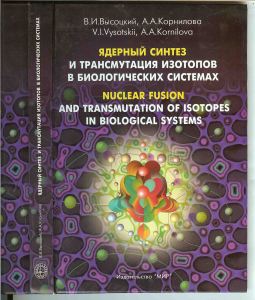
- At the conference I also obtained a copy of Vysotskii and Kornilova’s excellent book, Nuclear Fusion and Transmutation of Isotopes in Biological Systems
- The book’s contents have been summarised in their paper: Low-energy Nuclear Reactions and Transmutation of Stable and Radioactive Isotopes in Growing Biological Systems and also in the more accessible Transmutation of Stable and Radioactive Isotopes in Biological Systems.
- The New Physical Effects in Metal Deuterides paper presented by Mike McKubre;
- Cold fusion is an extremely controversial branch of physics. It studies a little understood phenomenon of low energy nuclear transmutation. Two of the many reasons why it is so controversial are;
- In their publications Vysotskii and Kornilova have demonstrated a thorough knowledge of their subject matter – both practically and theoretically;
- Their experiments were carefully designed to maximise their chances of success
- Their theory was entirely based on known physical and biological phenomena – no untested theories were invented after the facts;
- However, their theory limits the range of nuclear isotope (chemical element) transmutations that may be possible.
- One of the challenges I face in the writing of my book is to compare and contrast the range of other chemical element transmutation claims based on a historical review of previous research, with Vysotskii and Kornilova’s theory.
Goethe, Steiner and the Ancient Greeks
- Meanwhile I was studying Goethe’s holistic world view – which largely formed the philosophical foundations for Rudolf Steiner’s own teachings.
- I was fortunate to be able to take two third year undergraduate philosophy degree units after several years of my own private study. This enabled me to test the academic validity of such ideas;
- I have published a slightly modified version of one of my essays – it may be worth reading as an introduction to my understanding of Goethean science: Goethean Scientific Paradigm: Learning from History;
- The essay was exceptionally well received by my lecturer.
- I also studied Plato’s dialogue the Theatetus, in which his characters apparently fail to come up with a definition of knowledge;
- However, from my own studies of Goethe and his methodology – which I learnt from Henri Bortoft may be called an hermeneutic phenomenology – I spotted the character of Socrates embroiling his student in the parts-whole paradox in the final part of the dialogue – and no wonder they gave up – for the parts-whole paradox is the same as that of the chicken and the egg – if you don’t get it, you just go round and round in circles!;
- Sadly my essay was marked down – I had strayed from the required subject matter, and I didn’t have the courage to ask for more detailed feedback – but my lecturer did say that it showed insight.
- So far then, it appears that a Goethean science can be academically rigorous – if handled with care – for it is not mainstream.
- More recently I discovered that at least some philosophers – Gadamer, Mary Louise Gill, Joe Sachs, and hopefully others – consider the world views of both Plato and Aristotle to have been holistic in nature – and that they broadly agreed with each other;
- Most modern understandings of Plato are based on one-sided historical interpretations, emphasising only his ideal forms as expressed in the Republic;
- Most modern understandings of Aristotle are based on one-sided historical interpretations, emphasising only his formal logic and the rule of the excluded middle;
- Careful reading of their texts – in context – have enabled Aristotle’s apparent differences with Plato to be seen as merely later corrections to misleading or one-sided passages – to enable these individual parts to be better seen in the light of a greater whole – a vision which they both shared.
- Much to my surprise, whilst studying their predecessors, Plato and Aristotle’s understanding of reality – an holistic unity of material parts combined with an Ideal whole – can be found with every single one of their predecessors; from Pherecydes, Thales, Parmenides, Heraclitus, Empedocles, and Democritus – and others.
What Next!?
I have discovered a single unifying idea uniting all of the Ancient Greek natural philosophers up to Aristotle. After Aristotle I understand that the world conception became progressively more one-sided. Until the time of Goethe – by way of a counter-culture against an increasingly mechanistic science.
Rudolf Steiner gave a number of indications to mathematicians and scientists including how mathematics could provide an Ideal framework within which physical phenomena may be rightly placed and understood. The mathematics he recommended was projective geometry. The non-material forces which he called the four ethers – these he recommended being understood with the help of negative or counter-space.
Nick Thomas developed Steiner’s ideas to the point where he was able to provide at least the beginnings of an understanding of the many strange phenomena associated with the mysterious sub-sensible entity known today as an atom.
But neither Rudolf Steiner, nor Nick Thomas, has provided a new conception of the phenomenon of the biological transmutation of chemical elements (or more technically, isotopes). Though they may have come very close.
Beware of Greeks…
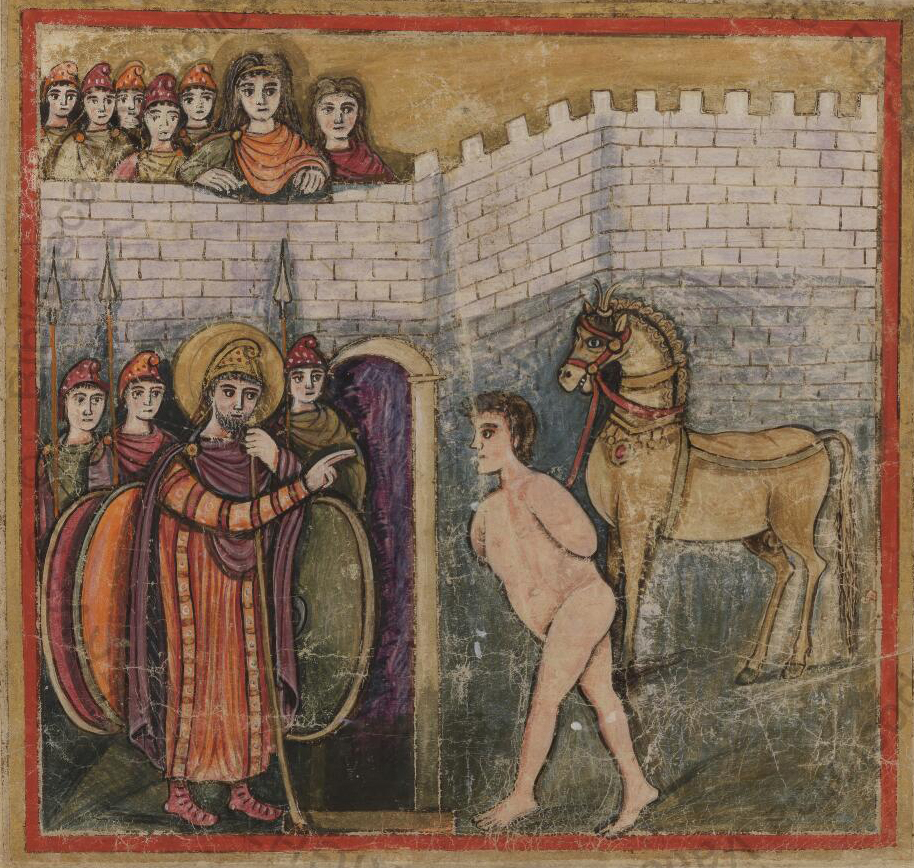
Beware of Greeks bearing gifts! So it is said. But perhaps – just perhaps in the incredibly challenging writings of Aristotle and his predecessors – there may be indications, potential understandings – a wooden horse to help me conquer Troy?
 Rethinking the Nature of Substance
Leave a comment