| This text is in a coloured box to separate it from the rest of the chapter. It is a comment about the second part of this working draft chapter, which started as a more or less conventional historical review of the early developments of chemistry in the West. The first parts of the Wikipedia page, History of Chemistry, were used as a template for this early draft. This update interweaves its content with Rudolf Steiner’s Riddles of Philosophy. Also used is E.J. Dijksterhuis, The Mechanization of the World Picture. |
Classical Antiquity and Atomism
Technological innovations may have been developed by this time, but their conception was not seen as we do today. They were not created or understood by means of abstract thought, but through imaginative (creative, but exact) thought pictures [Riddles of Philosophy, Rudolf Steiner]. However, from the time of Homer, and the advent of written Greek, humankind began to feel separate from the world of Gods and elemental beings. As Steiner said: “Their thought pictures developed as a tool of truth“.

Some consider the first Greek philosopher to have been Pherecydes. In his world conception everything was constituted through the actions of three Ideas (divine beings); Chronos, Chthon and Zeus.
[Footnote: Realists – such as the Ancient Greeks, Goethe, Steiner, and some twentieth century phenomenologists – believe(d) that ideas are entities which can be seen with our minds – that they have an existence independent of our minds. Unfortunately our own personal mental pictures are also called ideas – fuzzy representations of true ideas. To distinguish between the two, a true Idea is often written with a capital ‘I‘ – a custom I choose to follow here.
Steiner and the Ancient Greeks also believed that spiritual (divine) beings are entities which may be seen with our minds – they believed that all Ideas are divine beings. Rain, roses, naturally occurring copper, even man-made materials such as bronze – the essence or Idea of every entity – are all divine beings. And sensory qualities such as smoothness, reflectiveness, redness – everything and anything one can possibly experience – the Ancient Greeks believed they were all divine beings, seen with our minds.]
Of Pherecedes’ writings, only fragments survive, though others have written about his ideas. [Footnote: Except he would have understood that they were not his ideas. He had merely developed the ability to see them, along with the ability to find the words to communicate what he understood. In English we still say, when we understand something; ‘I see‘.]
According to Rudolf Steiner, in his Riddles of Philosophy, Pherecydes wrote of Chronos – the divine being of time – but not in the modern sense of measured clock time. Chronos was a being with the qualities or essence of time; it devours Chthon, a being with the qualities of earth, of the solid element. “Chronos lives in the activity of fire or warmth.” Again, this is not actual fire – as it is sensually experienced – it is the consuming activity of fire, of warmth, which is Chronos.
Zeus (or Zas), Steiner associated with the dissolving of water from liquid to vapour, and of clouds of vapour when they dissolve into the air. This is the action of spatially spreading or even the force of centrifugal extension (the etheric force as conceived of by Steiner).
Chthon (Chthonie) – Pherecydes’ third being – Steiner wrote that it was seen in the action of water becoming solid, or solid becoming fluid.
These three beings were seen as being interdependent. It is only through Zeus that Chronos consumes Chthon. [Footnote: It is worth pausing here and thinking about these beings – of their individual and collective natures. The threefold nature of the cosmos may be understood from their deeds and sufferings.]
In the view of Pherekydes the world is constituted through the cooperation of these three principles. Through the combination of their action the material world of sense perception — fire, air, water and earth — come into being on the one hand, and on the other, a certain number of invisible supersensible spirit beings who animate the four material worlds. Zeus, Chronos and Chthon could be referred to as “spirit, soul and matter,” but their significance is only approximated by these terms. It is only through the fusion of these three original beings that the more material realms of the world of fire, air, water and earth, and the more soul-like and spirit-like (supersensible) beings come into existence. Using expressions of later world conceptions, one can call Zeus, space-ether; Chronos, time-creator; Chthon, matter-producer — the three “mothers of the world’s origin.” We can still catch a glimpse of them in Goethe’s Faust, in the scene of the second part where Faust sets out on his journey to the “mothers.”
Rudolf Steiner, Riddles of Philosophy.
As Ideal qualities, Pherecydes’ three mothers were perfect, and represented what was (later known?) as the good (agathos). However, in the imperfections of the sensible world Pherecydes saw another being – Ophioneus – an agent of chaos.
Whoever sees the world only as it presents itself to image perception does not, at first, distinguish in his thought between the events of the “good mothers” and those of Ophioneus. At the borderline of a thought-formed world conception, the necessity of this distinction is felt, for only at this stage of progress does the soul feel itself to be a separate, independent entity. It feels the necessity to ask what its origin is. It must find its origin in the depths of the world where Chronos, Zeus and Chthon had not as yet found their antagonists. But the soul also feels that it cannot know anything of its own origin at first, because it sees itself in the midst of a world in which the “Mothers” work in conjunction with Ophioneus. It feels itself in a world in which the perfect and the imperfect are joined together. Ophioneus is twisted into the soul’s own being.
We can feel what went on in the souls of individual personalities of the sixth century B.C. if we allow the feelings described here to make a sufficient impression on us. With the ancient mythical deities such souls felt themselves woven into the imperfect world. The deities belonged to the same imperfect world as they did themselves.
Rudolf Steiner, Riddles of Philosophy.
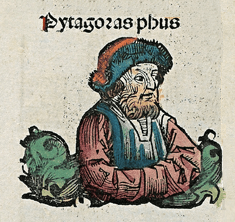
Pythagoras was said by some to have been a student of Pherecydes. He is famous for founding a spiritual brotherhood based on a belief that ‘the whole of the heavens is harmony and number‘ and that ‘all things are numbers‘ [Aristotle’s Metaphysics, cited by Dijksterhuis, The Mechanization of the World Picture]. This belief in the power of number had great consequences, by way of those whose ideas were influenced by Pythagoras and his disciples; these included Plato and Aristotle.
The spiritual brotherhood, which was founded by Pythagoras of Samos between the years 549 and 500 B.C. in Kroton in Magna Graecia, grew out of such a mood. Pythagoras intended to lead his followers back to the experience of the “Primordial Mothers” in which the origin of their souls was to be seen. It can be said in this respect that he and his disciples meant to serve “other gods” than those of the people. With this fact something was given that must appear as a break between spirits like Pythagoras and the people, who were satisfied with their gods. Pythagoras considered these gods as belonging to the realm of the imperfect. In this difference we also find the reason for the “secret” that is often referred to in connection with Pythagoras and that was not to be betrayed to the uninitiated… In what other form than in a brotherhood with a strictly regulated mode of life could the souls become aware of their lofty origin and still find themselves deeply bound up with imperfection? It was just through this feeling of deficiency that the effort was to be made to arrange life in such a way that through the process of self-perfection it would be led back to its origin.
…
Let us think of Pythagoras as standing before the beginning of intellectual world conception. He saw how thought took its origin in the soul that had, starting from the “mothers,” descended through its successive lives to its state of imperfection; Because he felt this he could not mean to ascend to the origins through mere thought. He had to seek the highest knowledge in a sphere in which thought was not yet at home. There he found a life of the soul that was beyond thought life. As the soul experiences proportional numbers in the sound of music, so Pythagoras developed a soul life in which he knew himself as living in a connection with the world that can be intellectually expressed in terms of numbers. But for what is thus experienced, these numbers have no other significance than the physicist’s proportional tone numbers have for the experience of music.
For Pythagoras the mythical gods must be replaced by thought. At the same time, he develops an appropriate deepening of the soul life; the soul, which through thought has separated itself from the world, finds itself at one with the world again. It experiences itself as not separated from the world. This does not take place in a region in which the world-participating experience turns into a mythical picture, but in a region in which the soul reverberates with the invisible, sensually imperceptible cosmic harmonies. It brings into awareness, not its own thought intentions, but what cosmic powers exert as their will, thus allowing it to become conception in the soul of man.
In Pherekydes and Pythagoras the process of how thought-experienced world conception originates in the human soul is revealed. Working themselves free from the older forms of conception, these men arrive at an inwardly independent conception of the “soul” distinct from external “nature.” What is clearly apparent in these two personalities — the process in which the soul wrests its way out of the old picture conceptions — takes place more in the undercurrents of the souls of the other thinkers with whom it is customary to begin the account of the development of Greek philosophy. The thinkers who are ordinarily mentioned first are Thales of Miletos (640 – 550 B.C.), Anaximander (born 610 B.C.), Anaximenes (flourished 600 B.C.) and Heraclitus (born 500 B.C. at Ephesus).
Rudolf Steiner, Riddles of Philosophy.
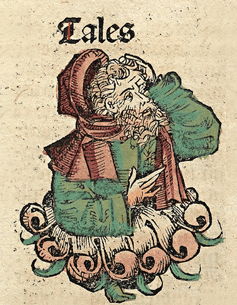
Thales most famously stated that the fundamental origin and being of all things was to be found in “water”. He was a contemporary of Pherecydes, and he founded the Milesian school, which introduced a conception of nature in terms of observable entities.
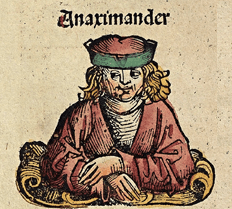
Anaximander most famously stated that the fundamental origin and being of all things was to be found in the “infinite” (apeiron). He was taught by Thales and became the second master of the Milesian school.
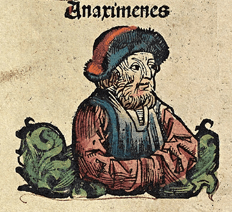
Anaximenes stated that the fundamental and origin and being of all things was to be found in “air”. He was either a younger friend or student of Anaximander at the Milesian school, and was the last of the renowned Milesian philosophers.
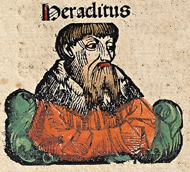
Heraclitus stated that the fundamental origin and being of all things was to be found in “fire”. Like Thales, Anaximander and Anaximenes before him, he was from the Ionian school (of which the Melesian school had been a part). They were collectively called the physiologoi (those who discoursed on nature) by Aristotle.
What is not considered in this treatment is the fact that these men are still really living in the process of the genesis of intellectual world conception. To be sure, they feel the independence of the human soul in a higher degree than Pherekydes, but they have not yet completed the strict separation of the life of the soul from the process of nature. One will, for instance, most certainly construct an erroneous picture of Thales’s way of thinking if it is imagined that he, as a merchant, mathematician and astronomer, thought about natural events and then, in an imperfect yet similar way to that of a modern scientist, had summed up his results in the sentence, “Everything originates from water.” To be a mathematician or an astronomer, etc., in those ancient times meant to deal in a practical way with the things of these professions, much in the way a craftsman makes use of technical skills rather than intellectual and scientific knowledge.
What must be presumed for a man like Thales is that he still experienced the external processes of nature as similar to inner soul processes. What presented itself to him like a natural event, as did the process and nature of “water” (the fluid, mudlike, earth-formative element), he experienced in a way that was similar to what he felt within himself in soul and body. He then experienced in himself and outside in nature the effect of water, although to a lesser degree than man of earlier times did. Both effects were for him the manifestation of one power. It may be pointed out that at a still later age the external effects in nature were thought of as being akin to the inner processes in a way that did not provide for a “soul” in the present sense as distinct from the body. Even in the time of intellectual world conception, the idea of the temperaments still preserves this point of view as a reminiscence of earlier times.
One called the melancholic temperament, the earthy; the phlegmatic, the watery; the sanguinic, the airy; the choleric, the fiery. [Footnote: See the Wikipedia entry for a general introduction to the four temperaments.] These are not merely allegorical expressions. One did not feel a completely separated soul element, but experienced in oneself a soul-body entity as a unity. In this unity was felt the stream of forces that go, for instance, through a phlegmatic soul, to be like the forces in external nature that are experienced in the effects of water. One saw these external water effects to be the same as what the soul experienced in a phlegmatic mood. The thought habits of today must attempt an empathy with the old modes of conception if they want to penetrate into the soul life of earlier times.
In this way one will find in the world conception of Thales an expression of what his soul life, which was akin to the phlegmatic temperament, caused him to experience inwardly. He experienced in himself what appeared to him to be the world mystery of water. The… phlegmatic temperament, when it is combined with an energetic, objective imagination, makes a sage out of a man because of its calmness, collectedness and freedom from passion. Such a disposition in Thales probably caused him to be celebrated by the Greeks as one of their wise men.
For Anaximenes, the world picture formed itself in another way. He experienced in himself the sanguine temperament. A word of his has been handed down to us that immediately shows how he felt the air element as an expression of the world mystery. “As our soul, which is a breath, holds us together, so air and breath envelop the universe.”
The world conception of Heraclitus will, in an unbiased contemplation, be felt directly as a manifestation of his choleric inner life. A member of one of the most noble families of Ephesus, he became a violent antagonist of the democratic party because he had arrived at certain views, the truth of which was apparent to him in his immediate inner experience. The views of those around him, compared with his own, seemed to him to prove directly in a most natural way, the foolishness of his environment. Thus, he got into such conflicts that he left his native city and led a solitary life at the Temple of Artemis. Consider these few of his sayings that have come down to us. “It would be good if the Ephesians hanged themselves as soon as they grew up and surrendered their city to those under age.” Or the one about men, “Fools in their lack of understanding, even if they hear the truth, are like the deaf: of them does the saying bear witness that they are absent when present.”
The feeling that is expressed in such a choleric temperament finds itself akin to the consuming activity of fire. It does not live in the restful calm of “being.” It feels itself as one with eternal “becoming.” Such a soul feels stationary existence to be an absurdity. “Everything flows,” is, therefore, a famous saying of Heraclitus. It is only apparently so if somewhere an unchanging being seems to be given. We are lending expression to a feeling of Heraclitus if we say, “The rock seems to represent an absolute unchanging state of being, but this is only appearance; it is inwardly in the wildest commotion; all its parts act upon one another.” The mode of thinking of Heraclitus is usually characterised by his saying, “One cannot twice enter the same stream, for the second time the water is not the same.”…
We do not consider a world conception in its full significance if we accept only its thought content. Its essential element lies in the mood it communicates to the soul, that is, in the vital force that grows out of it. One must realise how Heraclitus feels himself with his own soul in the stream of becoming. The world soul pulsates in his own human soul and communicates to it of its own life as long as the human soul knows itself as living in it. Out of such a feeling of union with the world soul, the thought originates in Heraclitus, “Whatever lives has death in itself through the stream of becoming that is running through everything, but death again has life in itself. Life and death are in our living and dying. Everything has everything else in itself; only thus can eternal becoming flow through everything.” “The ocean is the purest and impurest water, drinkable and wholesome to fishes, to men undrinkable and pernicious.” “Life and death are the same, waking and sleeping, young and old; the first changes into the second and again into the first.” “Good and evil are one.” “The straight path and the crooked… are one.”
Anaximander is freer from the inner life, more surrendered to the element of thought itself. He sees the origin of things in a kind of world ether, an indefinite formless basic entity that has no limits. Take the Zeus of Pherekydes, deprive him of every image content that he still possesses and you have the original principle of Anaximander: Zeus turned into thought. A personality appears in Anaximander in whom thought life is borne out of the mood of soul that still has, in the preceding thinkers, the colour of temperament. Such a personality feels united as a soul with the life of thought, and thereby is not so intimately interwoven with nature as the soul that does not yet experience thought as an independent element. It feels itself connected with a world order that lies above the events of nature. When Anaximander says that men lived first as fishes in the moist element and then developed through land animal forms, he means that the spirit germ, which man recognises through thinking as his true being, has gone through the other forms only as through preliminary stages, with the aim of giving itself eventually the shape that has been appropriate for him from the beginning. [Footnote: In modern terms one might consider this as a spiritual morphogenesis. For more on this see the chapter on Goethe.]
Rudolf Steiner, Riddles of Philosophy.
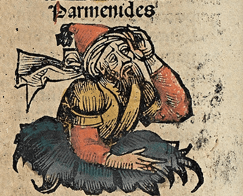
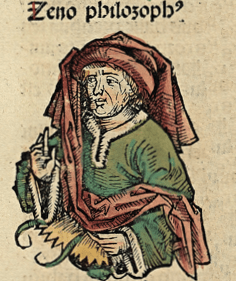
The Eleatic school of philosophers was most likely founded by Parmenides. He was most famous for stating that the “All is One”. The predecessor of his ideas was Xenophanes.
The thought element is already alive to such a degree in these thinkers that they demand a world conception in which the life of thought is fully satisfied; they recognise truth only in this form. How must the world ground be constituted so that it can be fully absorbed within thinking? This is their question.
Xenophanes finds that the popular gods cannot stand the test of thought; therefore, he rejects them. His god must be capable of being thought. What the senses perceive is changeable, is burdened with qualities not appropriate to thought, whose function it is to seek what is permanent. Therefore, God is the unchangeable, eternal unity of all things to be seized in thought.
Rudolf Steiner, Riddles of Philosophy.
Like Xenophanes, Parmenides rejected sensory experience as a source of truth. Truth is eternal, but material objects are subject to change and decay. The (Ideal) being of a material object is that which is eternal. That which is eternal cannot have a beginning or an end. It only ‘is‘.
| Existence, (the quality of) being, isness – all different words for a philosophically challenging concept associated with the Greek word ‘is‘. My own understanding is based on my studies of Goethe’s world view, as interpreted by Rudolf Steiner and Henri Bortoft. Consider a material object – my own favourite example is an individual rose bush. It exists – it has (an Ideal) being – it is. All rose bushes have the same is-ness. That is-ness is its non-material essence. It is Ideal, spiritual. It is a part of all existence, of universal being. All being is part of a unified whole. All is One. |
Parmenides expressed these ideas in a three part poem, On Nature, in the form of the earliest known logical argument.
The poem was in three parts:
- A proem (preface), which introduced the entire work,
- “The Way of Truth” (aletheia), and
- “The Way of Appearance/Opinion” (doxa).
The subject matter of the poem as a whole is central to the philosophical ideas developed by Plato in his theory of (Ideal) forms – of which more later. Parmenides, in this poem, demonstrated three things:
- The power of his own thinking to see Ideas which he said were shown to him by a divine being;
- His ability to communicate these ideas to others, and;
- His ability to demonstrate their truth by means of logical argument (“the art of thinking”).
What follows is “The Way of Truth”, which he later contrasts with “The Way of Seeming”, which has also been translated as “The Way of Mortal Belief”. The first part was concerned with the way to spiritual understanding (if we take the meaning of the word spiritual in the sense of the German word Geist, which means mental activity – and therefore includes thinking). Through our thinking we may see Ideal truths – which are timeless, and therefore immortal – as were his Gods.
The “Way of Seeming” relates to the physical world, which we see with our physical senses. Physical entities – including our own physical bodies – are prone to change and decay – they are mortal. As mere physical mortals we may be limited to our personal beliefs. However – by means of our thinking – we may travel at least part of the way along the path to the realm(s) of immortal truth.
Rudolf Steiner in Chapter 5 of his Philosophy of Freedom showed how only when a concept (the subject of Parmenides’ Way of Truth) is combined with a percept (the subject of Parminedes’ Way of Seeming) is a true picture of reality formed of the whole thing. [Though, Parmenedes and Heraclitus both have fragments in common – see Short Intro to Pre-Socratics] Unfortunately we may never know exactly what Parmenides wrote, for only fragments of his book survive. However, it is clear that his pupil Zeno wholeheartedly promoted “The Way of Truth” to the exclusion of knowledge gained from our physical senses.
| This is (more or less) as far as my third revision of this chapter has progressed. It has given me – and hopefully any readers – a feeling for the possible tone for the rest of the book. However, it is still early days. |

 Rethinking the Nature of Substance
Leave a comment